




Independent candidates supported by jailed former Prime Minister Imran Khan have emerged as the front-runners in Pakistan's national election after the final results were announced. These independent candidates secured 93 out of the total 264 seats in the National Assembly. Meanwhile, the party of another former prime minister, Nawaz Sharif, claimed the second spot with 75 seats, but fell short of a clear majority. Khan's independents ran as individuals, making it uncertain as to who will form the government.
Against the backdrop of ongoing coalition talks and protests blocking roads in the northern part of the country, the delayed release of the final vote tally has raised concerns. The election commission took more than 60 hours after voting ended to publish the results, creating further uncertainty and adding to the challenges Pakistan is currently facing.
Both former prime ministers, Imran Khan and Nawaz Sharif, have declared victory, further adding to the confusion surrounding the formation of a government. This uncertainty comes at a time when Pakistan is dealing with urgent issues such as negotiating a new International Monetary Fund program to stabilize the struggling economy.
To become the prime minister, a candidate needs to secure a simple majority of 169 seats in the National Assembly. This requires coalition talks and the potential for Khan-backed candidates to join forces with smaller parties to gain enough seats for a single bloc.
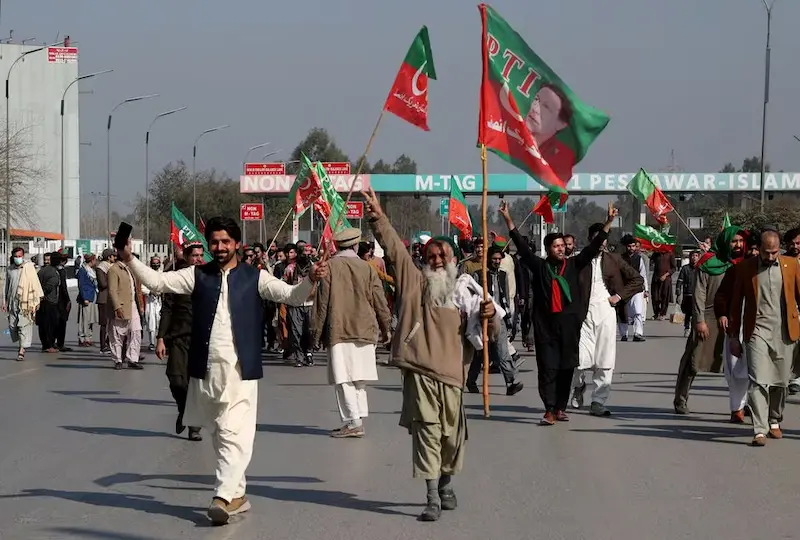
Amid these developments, Imran Khan's Pakistan Tehreek-e-Insaf (PTI) party had threatened nationwide peaceful demonstrations if the vote tally was not released promptly. While a large-scale protest was called off, there were reports of PTI supporters blocking traffic in Peshawar. The Pakistani interim government cited communication issues and a mobile internet outage on election day as reasons for the delay, although this move raised concerns over freedom of expression and human rights.
In addition to the challenges of forming a government, Khan's PTI party faced technical constraints that prevented their candidates from contesting under the party's symbol. Consequently, many PTI supporters ran as independents, leading to their success in securing seats in the National Assembly. However, these independent candidates may face disadvantages as they are ineligible for the allocation of reserved seats in parliament.
Nawaz Sharif's party has been engaging in discussions with representatives of the regional Muttahida Qaumi Movement (MQM) party. Although they have not reached a formal coalition agreement, there seems to be an agreement in principle to work together for the country's greater good.
The election commission has also highlighted that results for two seats are pending. One seat was postponed due to the killing of a candidate, while polling for the other is set to be completed later this month. These outstanding seats could have further consequences for the composition of the newly-formed government.
As Pakistan faces a multitude of pressing issues, including economic stability and political stability, the formation of a government remains uncertain. The coming days will be crucial, as coalition talks will determine who ultimately takes the reins of power in the country.