


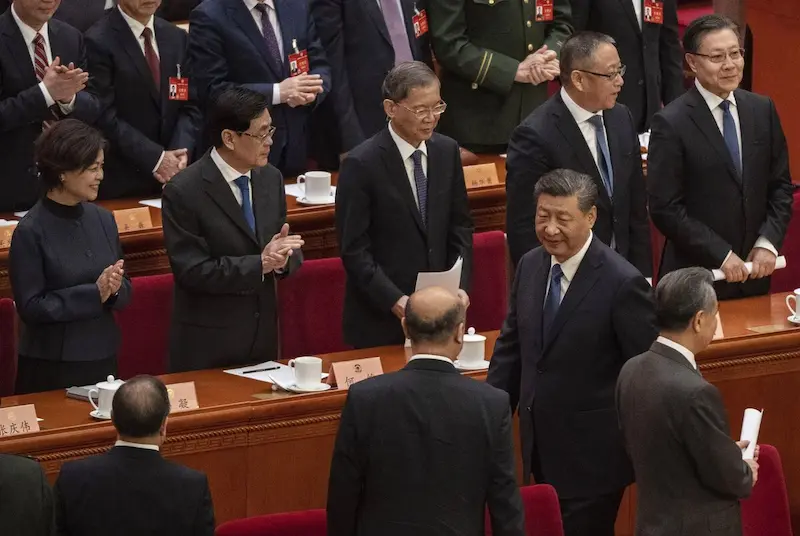


In a significant move aimed at tightening the Communist Party's grip on the government, the Chinese legislature recently voted to amend a long-standing law that governs the State Council. The amendments, approved by a vast majority of delegates at the National People’s Congress meeting in Beijing, underscore President Xi Jinping's ongoing efforts to consolidate party control over key government functions.
The changes to the State Council Organic Law, the first since its adoption in 1982, prioritize the party's leadership within the cabinet and underscore the need for adherence to specific ideologies, including Xi Jinping Thought. These amendments signal a shift towards increased party oversight over the State Council, further blurring the lines between party directives and government operations.
The updated law, the specific wording of which has not been made public yet, falls in line with Xi's overarching agenda to elevate the Communist Party's influence across various sectors of society. Over his tenure, Xi has diligently worked to embed party representation in all spheres of public and private life, from corporate governance to educational institutions.
Last year, Xi spearheaded a restructuring of the party, which included establishing separate financial bodies to take control of key committees previously under the State Council's purview. This move aimed to centralize power within the party and ensure a more direct influence over critical strategic decisions.
The recent amendments to the State Council Organic Law are poised to safeguard Xi's vision of party-led governance for the future. By institutionalizing party control over the cabinet, these changes pave the way for a seamless continuation of Xi's policies and directives beyond his tenure.
As China navigates a challenging economic landscape, characterized by efforts to transition towards high-quality development amidst global uncertainties, the party's increased oversight over the government signifies a strategic alignment of political and economic objectives. Despite external pressures such as the pandemic-induced economic slowdown and trade tensions, the party's assertive leadership at the helm of the government aims to ensure policy continuity and effective implementation.
The convergence of party leadership and government functions, as outlined in the amended law, reflects a departure from the separation advocated during Deng Xiaoping's era of reform and opening in the 1980s. As the party asserts control over decision-making processes within the State Council, investors and observers are likely to scrutinize the implications of this centralized authority structure on policy execution and regulatory frameworks. Ultimately, the consolidation of party control over the cabinet underscores a broader shift towards a more integrated, party-centric governance model in contemporary Chinese politics.