


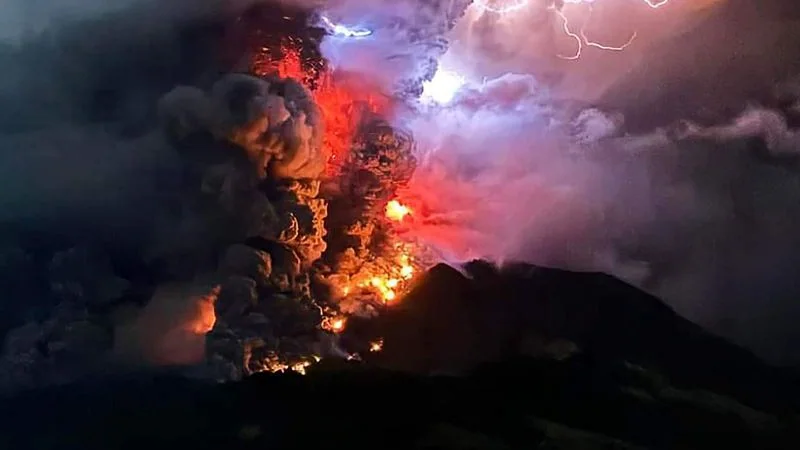


A series of powerful eruptions from the remote Mount Ruang volcano on Ruang Island, North Sulawesi, have prompted Indonesian authorities to issue a tsunami warning, urging hundreds of villagers to evacuate immediately. The volcano, standing at 725 meters (2,400 feet), has erupted multiple times since Tuesday night, spewing fiery lava and ash plumes that reached thousands of feet into the sky, as reported by the country's volcanology agency.
In response to the escalating volcanic activity, the authorities have raised the alert level to the highest possible, cautioning individuals to stay at least 6 kilometers (3.7 miles) away from the volcano summit. There are concerns that Mount Ruang may partially collapse into the sea, potentially triggering a tsunami, similar to the devastating event in 1871. Hendra Gunawan, the chief of the volcanology agency, highlighted that recent earthquakes in the region have likely contributed to the intensifying eruptions observed at Mount Ruang.
As a stratovolcano, Mount Ruang possesses a conical shape, characterized by steep slopes. Due to the sticky nature of its lava, stratovolcanoes are prone to explosive eruptions caused by gas accumulation within the magma chamber. The eruptive activity on Wednesday was captured in dramatic footage showing gray ash clouds rising into the sky, accompanied by streams of glowing lava and lightning strikes. Villagers residing on Ruang Island, home to approximately 800 people, have been evacuated to the neighboring Tagulandang Island as a precautionary measure.
Authorities have also advised residents of Tagulandang Island to remain vigilant for falling incandescent rocks and hot cloud surges. Thankfully, no casualties have been reported thus far. Indonesia, with its vast archipelago and over 120 active volcanoes, is situated along the Ring of Fire, a horseshoe-shaped belt of seismic activity around the Pacific Ocean. The country has a history of deadly volcanic eruptions, with the 2018 Anak Krakatau event resulting in a catastrophic tsunami that claimed the lives of more than 400 people along the coasts of Java and Sumatra islands.