


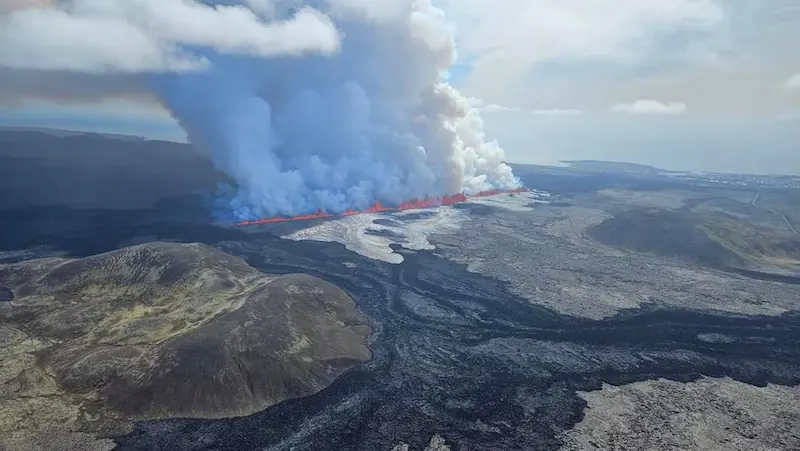


On Wednesday, a volcano stationed in the southwest region of Iceland spewed molten lava more than 50 metres into the atmosphere. This activity is the fifth of its kind since December and happens to be the most potent since the volcano reignited three years ago.
Prior to this explosive occurrence, officials had cautioned about the possibility of increased volcanic activities within the area located south of the capital city, Reykjavik. This prediction was based on data collected from research that pointed to magma accretion underground. The explosive eruption occurred not long after the completion of an eight-week-long eruption that transpired between Hagafell and Stora-Skogfell, which both lie on the Reykjanes peninsula.
As per the Icelandic Meteorological Office, the lava spewed from the volcano formed a fountain that escalated to a height of 50 metres, while the fissure extended approximately 3.4 km in length. The bureau confirmed, "In comparison to previous eruptions, the beginning of this eruption is significantly more forceful."
Even amidst such a volatile incident, operations at Reykjavik's Keflavik Airport went ahead without disruptions, as noted on the airport's website.
The recent spectacular display of natural fury underscores the predicaments this island country, home to nearly 400,000 inhabitants, grapples with. Scientists warn that the Reykjanes peninsula, housing around 30,000 people, could witness a stream of such eruptions periodically for several decades or perhaps centuries. Wednesday's eruption marked the eighth such event on the peninsula since 2021, following the reactivation of geological systems that had been static for 800 years.
Ari Trausti Gudmundsson, a geophysicist from Iceland, described the incident as a traditional fissure eruption with high lava inconsistencies. He anticipates that these lava fountains will gradually subside, and the eruption could progress for days or weeks.
The ongoing volcanic activities have wreaked havoc on district heating infrastructure, necessitating the closure of vital roads, and demolishing several dwellings in the Grindavik fishing town. Only a handful of residents have returned following an evacuation in 2023. To prevent further destruction, human-made barriers have been erected to deflect the lava away from crucial areas, including the Svartsengi geothermal power station, the Blue Lagoon spa, and Grindavik.
As the latest condition deteriorates, the Icelandic civil defense has been put on high alert and the Grindavik region has been ordered to evacuate yet again. The renowned Blue Lagoon geothermal spa, famous for its luxurious outdoor pools, was forced to close down and guests were evacuated. Iceland, known as the "Land of Fire and Ice," features a unique natural landscape of mountainous peaks, icy terrains, and fjords and is situated between the Eurasian and North American tectonic plates.