


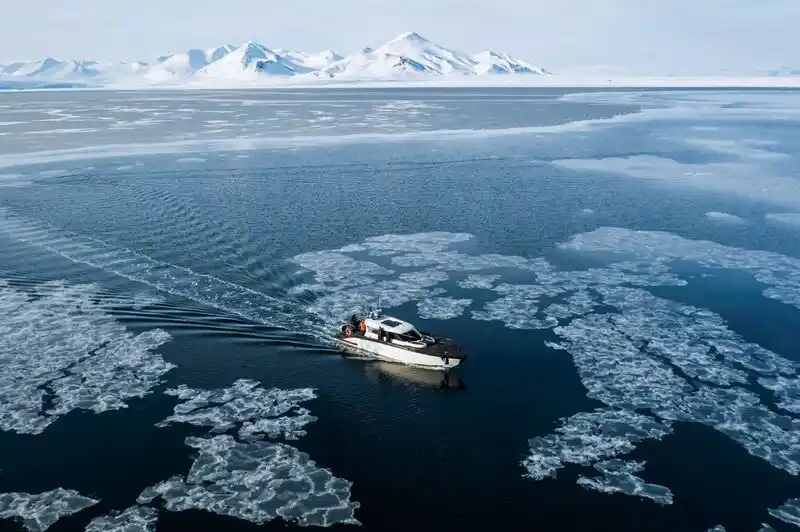


New research has found that the Arctic could be ice-free during summer months before 2040. The United Nations Intergovernmental Panel on Climate Change had previously suggested that this could happen around 2050 if greenhouse gas emissions continue at moderate or high levels. However, the new study, published in Nature Communications, shows that this is more likely to happen in a low-emissions scenario, while higher emissions would cause ice-free Septembers between 2030 and 2040.
The loss of Arctic sea ice has global ramifications, such as narrowing the temperature gap between the Arctic and lower latitudes, intensification of jet stream fluctuations, permafrost melting, triggering a dangerous feedback loop, and quickening Greenland ice sheet melting, leading to higher seas.
“This study separates and quantifies human-made greenhouse gas impact on ice loss from other natural factors and finds that 90% of Arctic sea-ice melting is anthropogenic and 10% is natural,” said Seung-Ki Min, a study and IPCC author and an environmental science professor at South Korea’s Pohang University of Science and Technology. While fluctuations in weather patterns are almost impossible to predict, knowing that the loss of sea ice is mostly caused by human activity means people can work to slow down the loss, explained Dirk Notz, an oceanographer at the University of Hamburg and an author of the study.
As the climate modeling improves, Notz expects that more studies of other Earth systems will appear, delivering bad news like this study and revealing that it's too late to do something.