


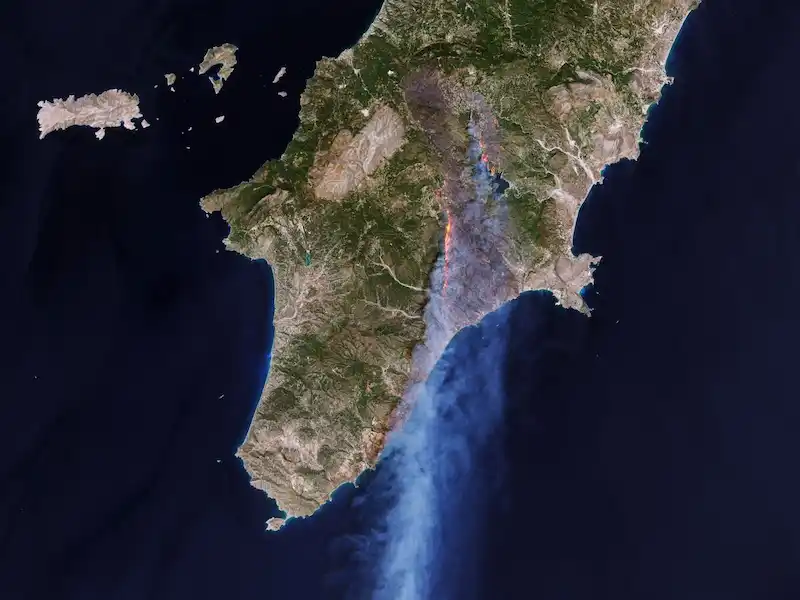


Greece is currently facing a severe wildfire crisis as raging fires continue to sweep across the country's islands. Over the past 24 hours alone, 162 fires have been reported in Greece amidst high winds and extreme heat. As a result, about 19,000 people were evacuated from the island of Rhodes over the weekend, and another 2,466 tourists and residents were evacuated in northern Corfu. The situation remains critical as more villages on Rhodes are under threat, prompting further evacuation orders.
Greek Prime Minister Kyriakos Mitsotakis addressed the parliament on Monday, acknowledging the severity of the situation and stating that "we are at war" with the ongoing climate crisis. Southern Europe has been hit hard by extreme weather this summer, experiencing hailstorms, tornadoes, heavy rainfall, and strong winds. Italy's Sardinia, in particular, has been hit by scorching temperatures, coming close to Europe's record high temperature. A temperature of 48°C (118.4°F) was recorded in Jerzu, Sardinia on Monday, just below the European record of 48.8°C set in Sicily two years ago.
The extreme weather conditions have caused disruptions not only for residents and tourists but also for airlines. Three EasyJet flights had to be diverted from Olbia in Sardinia due to the excessively hot runway, while a Delta Air Lines flight from Milan to New York had to be diverted to Rome after hail damaged the aircraft.
Despite these record-breaking temperatures and the undeniable evidence of climate change, energy ministers from the Group of 20 failed to reach a consensus on phasing down fossil fuels during a recent meeting in India. The global warming caused by greenhouse gas emissions is leading to more intense and prolonged heatwaves across the Northern Hemisphere, raising concerns about the habitability of certain areas.
The Greek government has been coordinating firefighting and rescue efforts with assistance from the European Commission, the UK, France, and Italy. Over 260 firefighters, along with aircraft support, are battling the blaze on Rhodes. Efforts are also being made to repatriate stranded tourists, with EasyJet, Jet2, TUI, and Ryanair offering assistance in bringing visitors back to their home countries.
The crisis has posed a dilemma for Greece, as many of its islands rely heavily on tourism, especially during the summer season. The country's Tourism Minister, Olga Kefalogianni, has encouraged visitors to continue traveling to popular destinations such as Corfu and Rhodes, despite the ongoing challenges.
In addition to Greece, other countries in Europe are also battling wildfires, with parts of southern France facing a high risk. However, Northern Europe is experiencing cooler temperatures, with the UK, Germany, France, and Nordic countries below seasonal averages. London, for example, is expected to reach a maximum of 18°C, which is 5°C below the seasonal average, according to weather forecasters.
The situation remains alarming, and efforts are underway to control the wildfires and support affected communities. The impact of climate change on extreme weather events serves as a stark reminder of the urgent need for collective action to mitigate and adapt to the changing climate.