




Italy's banks are facing the repercussions of Prime Minister Giorgia Meloni's attempts to cater to the more populist elements within her right-wing coalition. The recent pact between Meloni and Deputy Premier Matteo Salvini, which involved a surprise 40% tax on bank earnings, sent shockwaves through the markets. This decision was made during a dinner between Meloni and Salvini, where they discussed the tax over Fiorentina steak and Chianti wine on the Tuscan coast.
Unfortunately, this last-minute decision meant that the policy was announced by Salvini without proper planning and was full of loopholes. As a result, finance ministry officials spent the following days trying to figure out how to implement the tax and reassure investors as bank stocks plummeted. The constant changes and lack of clarity surrounding the levy caused around $10 billion to be wiped from the banks' market value before shares slowly began to recover.
It was only on Wednesday afternoon, after days of confusion, that Meloni finally addressed the issue. In a Facebook video, she justified the tax by pointing to the banks' behavior and questioning the efficacy of the European Central Bank's interest rate hikes. She claimed that banks were making record profits without passing on the benefits to consumers, hence the need for government intervention in the form of taxes.
However, this sudden and poorly executed tax announcement has significantly damaged Italy's reputation. Carlo Alberto Carnevale Maffe, a professor of business strategy, describes it as a "self-destructive move" that undoes the credibility the government had been building with a cautious approach towards markets and investors. The constant changing of details surrounding the levy has only added to the sense of uncertainty and unpredictability for investors.
This is not the first time Meloni has caused instability in the markets. In April, she created turmoil by making a last-minute deal with Salvini, nominating Flavio Cattaneo for a position instead of her preferred choice. Each time, Meloni remains silent, allowing the market to react and waiting for the storm to pass.
Meloni's silence and distance from the tax announcement can be seen as a strategic move to give Salvini a political victory and maintain her image as a pro-market figure. However, it is believed that she supports the tax in order to solidify her alliance with Salvini and secure the electoral base of her far-right Brothers of Italy party.
Italy's political landscape has been in flux since the death of former premier Silvio Berlusconi, leaving his Forza Italia party without its leader and creating an opportunity for Meloni and Salvini to become the dominant figures on the Italian right. This further highlights the importance for Meloni to pacify her allies and prevent any potential government crises.
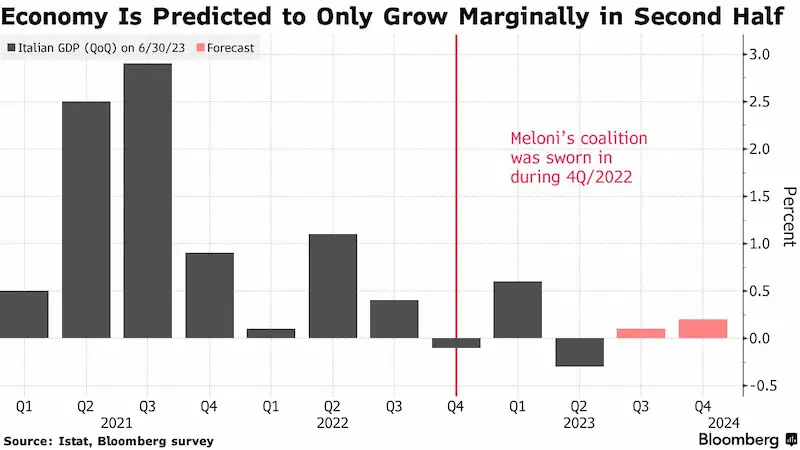
While Meloni's strategy of appeasement has allowed her to remain in power, the long-term impact of such uncertainty on investors remains uncertain. So far, her economic policies have been well received, maintaining the country's declining debt trajectory and avoiding excessive spending. However, the recent tax announcement raises concerns and may lead investors to question what could come next. This uncertainty is happening against a backdrop of weakening economic growth, which only adds to the unease in the markets.