


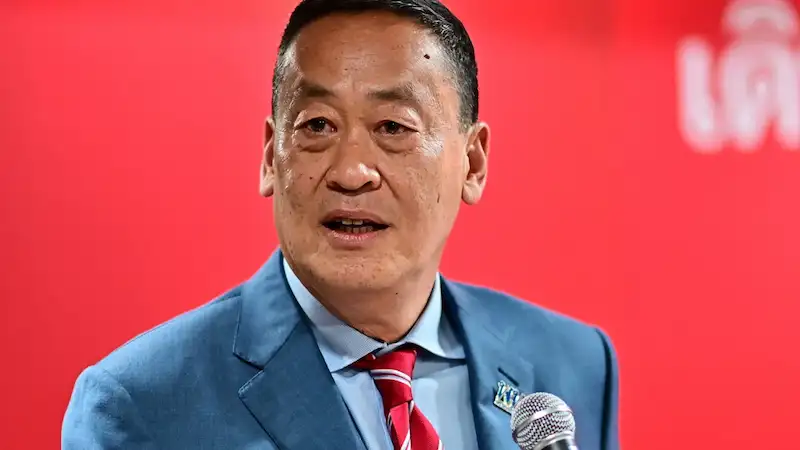


After three months of political deadlock, Thailand's parliament has finally chosen real estate tycoon Srettha Thavisin as the country's next prime minister. Thavisin, who was the sole candidate put forward by the populist Pheu Thai Party, secured 482 out of 747 possible votes in Thailand's bicameral parliament.
Coinciding with Thavisin's election, the controversial former prime minister Thaksin Shinawatra, founder of the Pheu Thai Party, has returned to Thailand after more than 15 years of self-imposed exile. However, Thavisin's appointment still awaits endorsement by King Maha Vajirilongkorn before he can officially assume office.
Expressing his gratitude, Thavisin pledged to improve the lives of the Thai people across the country. He stated, "I feel greatly honored to be elected as the 30th prime minister of Thailand. I would like to thank every Thai, coalition parties, honorable members of the House of Representatives, and every senator who joined the vote today. I will try my best in doing my duties tirelessly to elevate Thais' lives."
Srettha Thavisin is known for his business acumen rather than his political experience. He joined the Pheu Thai Party in 2022 and was subsequently nominated as one of the party's prime ministerial candidates prior to the May election. Move Forward, a progressive party that won the May election with a promise of significant reforms, faced challenges in forming a government due to opposition from the political elites.
Pheu Thai, which secured second place in the election, took the lead in forming a new alliance after Move Forward's aspirations were blocked by parliament. However, in order to secure the necessary votes, Pheu Thai struck a deal with its former military rivals, therefore breaking its promise not to collaborate with pro-military parties.
Under the new alliance, the military-backed Palang Pracharath and United Thai Nation Party will be given ministerial roles. Both these parties are affiliated with coup leader and outgoing Prime Minister Prayut Chan-o-Cha, and linked to the military junta that overthrew Pheu Thai's democratically elected government almost a decade ago.
This move has frustrated the millions of Thais who voted for progressive parties, as it undermines their desire for real change and delivers a strong rebuke to the military-backed establishment that has governed Thailand since the 2014 coup.
With Move Forward now in the opposition, the formation of the new government is likely to ignite the progressive movement's youthful support base, possibly leading to mass street protests. A survey conducted by the National Institute of Development Administration revealed that about 64% of respondents disagreed with the idea of Pheu Thai forming a government with its military-backed rivals.
The return of Thaksin Shinawatra further adds uncertainty to the already tense political climate. Despite being in exile, Thaksin has exerted a significant influence on Thai politics. His parties have consistently won the most seats in elections since 2001, yet have struggled to maintain power due to military interference.
In an interview prior to the May election, Srettha Thavisin emphasized that he is not a proxy for Thaksin and expressed his intention to address income inequality, promote LGBTQ+ rights, combat corruption, and elevate Thailand's international standing. He also emphasized the need for economic revitalization, proposing a large economic stimulus to boost Thailand's recovery.
However, given the coalition involving bitter military rivals, it remains uncertain whether Pheu Thai will be able to govern effectively. Srettha Thavisin, who is not a member of parliament, was educated in the United Kingdom and the United States and holds a master's degree in finance from Claremont Graduate School. He previously worked for Procter & Gamble in Thailand and later founded the real estate company Sansiri with his brother.