


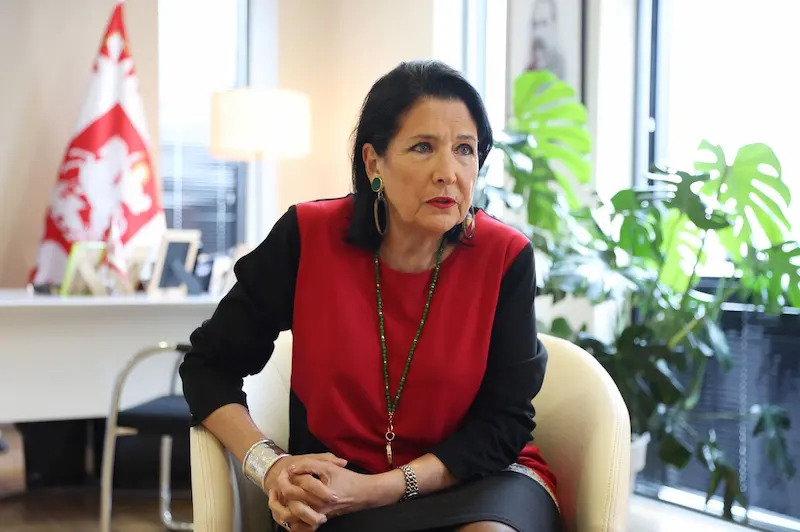


Georgia's ruling party, Georgian Dream, has initiated impeachment proceedings against President Salome Zourabichvili after she defied a government attempt to ban her from making state visits abroad. This unprecedented move comes as Zourabichvili embarked on a series of official visits to countries such as Germany, Switzerland, Poland, Belgium, and others, with the aim of lobbying for Georgia's EU membership.
The relationship between Zourabichvili and Georgian Dream, backed by the country's wealthiest man, Bidzina Ivanishvili, has been deteriorating recently. Despite being elected with support from Georgian Dream in 2018, Zourabichvili has increasingly clashed with the government, particularly regarding the issue of supporting Ukraine against Russia's invasion.
Zourabichvili's visit to Germany was planned as the starting point for meetings with European leaders in support of Georgia's candidacy for EU membership. However, the government in Tbilisi retaliated by announcing that she had been denied permission to make any of the planned state visits, asserting that the president can only exercise representative powers in foreign relations with the consent of the government, according to the constitution.
Georgian Dream's chairman, Irakli Kobakhidze, announced the impeachment proceedings, arguing that Zourabichvili's decision to travel without government consent undermines their efforts to gain support for EU candidate status. Impeachment in Georgia requires the support of 100 parliament members, which is unlikely without some opposition support. Therefore, Georgian Dream plans to first seek a Constitutional Court ruling stating that the president breached the constitution.
Georgia has been striving for EU and NATO membership since the Rose Revolution in 2003, aiming to distance itself from Russia's influence. However, the country has been lagging behind Ukraine and Moldova, both of which were granted EU candidate status last year. The pace of reforms in Georgia has been criticized by Brussels, hindering its progress towards EU membership.
Zourabichvili has been openly critical of the government's failure to support Ukraine in its conflict with Russia. She believes that those who oppose her stance on this issue are attempting to create a second front in Georgia, where Russian forces still occupy a significant portion of the country since the 2008 war over the breakaway regions of Abkhazia and South Ossetia.
In addition to her stance on the Ukraine-Russia conflict, Zourabichvili has also condemned the Georgian government's proposed "foreign agents" law, which drew comparisons to similar legislation used by President Vladimir Putin in Russia to suppress dissent. Following public protests and international criticism, the government ultimately backed down from implementing the controversial law.
Moreover, Zourabichvili opposed Russian President Putin's decision to restore air travel links with Georgia, which was welcomed by the Georgian government. She described this move as a "provocation." These incidents have further strained her relationship with Georgian Dream and prompted the party to take drastic action against her.
The impeachment proceedings against President Zourabichvili reflect a deepening political crisis in Georgia and pose challenges to the country's aspirations for EU membership. It remains to be seen how this conflict between the president and the ruling party will unfold and impact Georgia's political landscape in the coming months.