


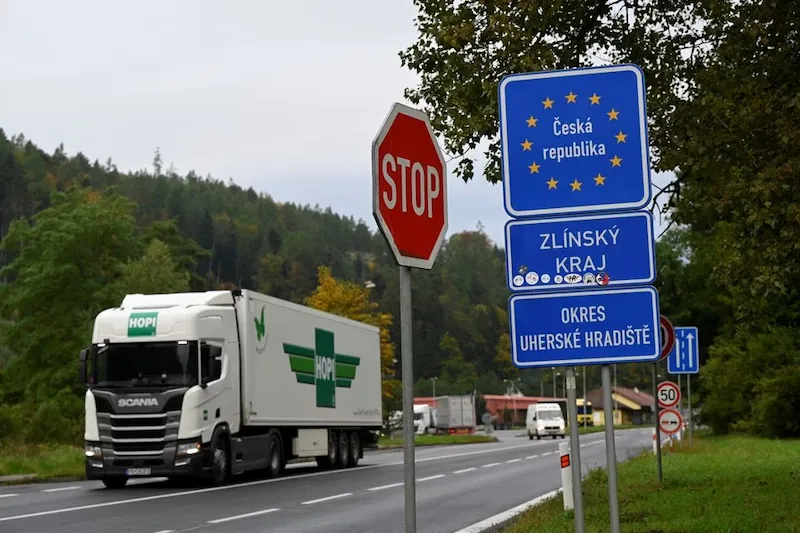


The Czech Republic and Poland have jointly announced the implementation of border checks along their borders with Slovakia in a bid to tackle illegal migration and clamp down on smuggler activity. Austria has also decided to follow suit, leading to tensions and a sense of discontent in Slovakia. The border controls are set to begin from Wednesday and will continue for a minimum of 10 days.
The issue of illegal migration has been a controversial and unifying topic in Central Europe. The Czech Republic, Hungary, Poland, and Slovakia have previously joined forces in opposition to the European Union's migration plans, particularly the idea of quotas. However, as all these countries are part of the EU's Schengen visa-free zone, the reintroduction of border controls during periods of increased migrant flows has caused political and trade friction.
The problem of illegal migration played a significant role in the recent elections in Slovakia and is expected to be a key issue in the upcoming elections in Poland later this month. Czech Interior Minister Vit Rakusan stated that the border controls are necessary to effectively combat smuggling operations and illegal migration. These measures will involve random checks along the entire border, aiming to minimize disruption to cross-border traffic.
Following the Czech and Polish actions, Austrian Interior Minister Gerhard Karner announced that Austria would also implement border checks along its border with Slovakia. This decision aligns with Austria's policy of matching the Czech controls to prevent any potential spillover of illegal migration into its territory.
The government of Slovakia has expressed its dissatisfaction with the actions taken by its neighboring countries. Slovak caretaker Prime Minister Ludovit Odor emphasized the need for a European solution to the issue, indicating that the problem cannot be effectively addressed through unilateral actions. Slovakia has faced an increasing number of illegal migrants crossing its borders as they attempt to reach Germany and other western European countries. Most of these migrants are young men from the Middle East and Afghanistan, primarily entering through the so-called Balkan route via Hungary from Serbia.
The issue of illegal migration has gained significant attention during the recent Slovak elections, with former Prime Minister Robert Fico taking a hardline stance on the matter. His party emerged victorious and is now attempting to form a new government, with securing the border with Hungary as a top priority. Although Slovakia acknowledges the challenges of completely sealing its 655km border, it has deployed up to 500 soldiers to assist in border patrols.
Slovakia reported a nine-fold increase in the number of detained illegal migrants last month, surpassing 27,000 for the year. Prime Minister Ludovit Odor warns that the unilateral actions of countries can trigger a "cascade effect." He highlighted that in this case, Poland initiated the process, likely driven by the upcoming pre-election period, followed by the Czech Republic.
The issue of illegal migration is expected to remain a central theme in the upcoming Polish elections, scheduled for October 15. The ruling Law and Justice (PiS) party has prominently featured ads highlighting the threat of illegal migration, reflecting the party's stance on the issue. Polish Interior Minister Mariusz Kaminski stated that Poland has witnessed a significant rise in illegal migration in recent weeks, with 551 illegal migrants detected and detained at the Slovak border. He emphasized the urgency of taking decisive action to address the situation.