


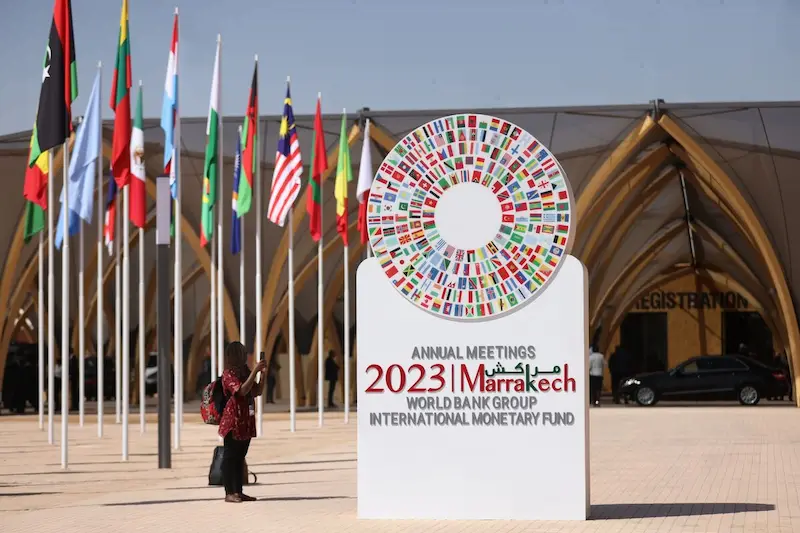


The annual meeting of the International Monetary Fund’s (IMF) top advisory board ended with a lack of consensus, once again highlighting the challenges posed by Russia’s war in Ukraine. Rather than a communique, the board released a chair’s summary, as representatives of its 190 member countries were unable to agree on a joint statement. Meanwhile, the IMF panel, officially known as the International Monetary and Financial Committee, did agree to update its voting shares in the future to better reflect the economic strength of its members. However, this decision has put the US at odds with China and other emerging economies, who are seeking larger shares.
The IMF and Group of 20 (G-20) have both struggled to maintain a unified voice amidst geopolitical divisions, as evidenced by statements made at their annual meetings held in Marrakech, Morocco. The G-20 managed to reach a consensus by avoiding direct references to the Israel-Hamas war, thus sidestepping potential gridlock among its members. On the other hand, some European nations within the IMF sought to include stronger language condemning Russia’s invasion of Ukraine. However, they were unable to reach an agreement, despite working through the night.
The chair of the IMF panel, Spanish Economy Minister Nadia Calvino, stated that while most members recognized the devastating humanitarian consequences and negative impact on the global economy caused by Russia's invasion of Ukraine, others held differing views and assessments of the situation. The lack of consensus reflects the ongoing challenges faced by international organizations in promoting multilateralism amid a fragmented world.
In terms of reforms, the IMFC announced its commitment to implementing "meaningful" increases in quotas by the end of the year. This refers to the share of funds each IMF member contributes, with the aim of enhancing the organization’s finances and reducing reliance on ad-hoc bilateral funding agreements. Additionally, the committee stated that the IMF's executive board should develop possible approaches for further quota realignment, including the use of a new quota formula, by June 2025.
However, any changes to voting shares would require approval from the US Congress. The US has been reluctant to support policies that would increase China's influence, given their geopolitical rivalry. US Treasury Secretary Janet Yellen reiterated the country's stance on an "equiproportional" increase in quotas, which would raise overall resources without altering voting weight proportionally. Meanwhile, countries such as China, Brazil, and India, whose economies have witnessed rapid growth compared to developed nations, have long been advocating for a redistribution of quotas to reflect their increasing economic significance. China currently holds just a 6% share in the IMF, despite accounting for around 18% of global economic output.
While acknowledging the political realities in the US, Brazil's Finance Minister Fernando Haddad emphasized the importance of eventually updating the IMF's voting shares as failure to do so would weaken the organization in the long run. The issue of voting shares serves as a reminder of the complex dynamics at play within international institutions, as different countries seek to assert their influence and shape global economic governance.