


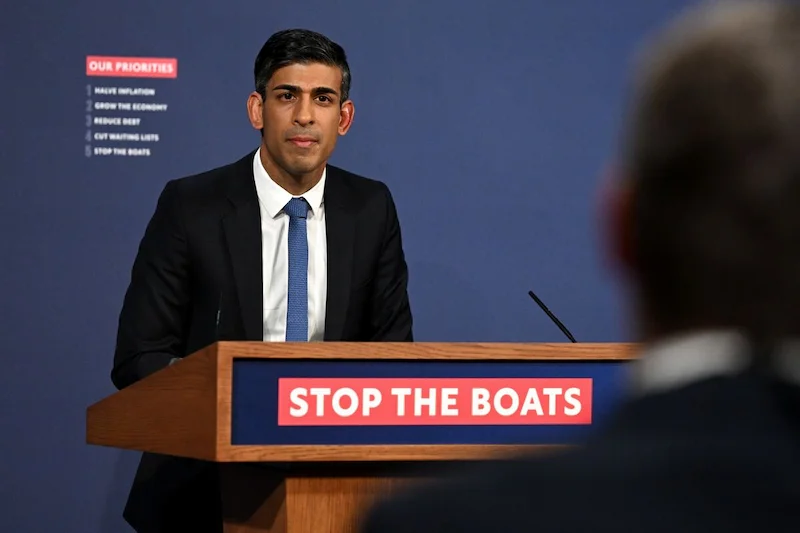


Prime Minister Rishi Sunak is facing an uphill battle as he attempts to quell a furious backlash from the right of his Conservative Party following a Supreme Court ruling that deemed his plan to deport asylum seekers to Rwanda illegal. In a tense session of Parliament, Sunak reaffirmed his commitment to stopping migrants from arriving in small boats across the English Channel, suggesting that he is willing to change British laws and enact emergency legislation to assert the legality of the Rwanda plan.
Sunak acknowledged the concerns raised by the Supreme Court and stated that ministers are working on a new treaty with Rwanda to address these concerns. The proposed treaty aims to guarantee that asylum seekers processed in Rwanda will not be sent back to their home countries, a practice known as "refoulement." Home Secretary James Cleverly later explained to the Commons that the treaty would ensure that those sent to Rwanda could not be re-deported to countries other than the UK. However, it remains uncertain whether this proposed solution would satisfy the courts or appease the disgruntled Tory MPs.
Legal experts argue that it will be an uphill battle for the government to persuade the courts, given the emphatic ruling against the Rwanda plan. Additionally, significant investments would be required to enhance Rwanda's asylum processing capacity, making it unlikely for any progress to be made in the short or medium term.
Downing Street had hoped for a more favorable Supreme Court verdict that would have facilitated an easier resolution. However, the ruling was more damning than anticipated, leaving any attempts to deport people to Rwanda under a new treaty vulnerable to legal challenge.
The controversy surrounding the deportation of asylum seekers to Rwanda is a pivotal issue for Sunak, as it forms a cornerstone of his pledge to "stop the boats." Firing former home secretary Suella Braverman on Monday further heightened tensions within the party, as she criticized Sunak's lack of a "credible Plan B" in the event of the government’s defeat in the Rwanda case.
Right-wing Tory MPs are increasingly frustrated with the ongoing immigration issue, particularly the number of migrants crossing the English Channel from France. Sunak's stance on immigration is seen as a significant factor in boosting the party's popularity and narrowing the gap with the opposition Labour Party in the run-up to the general election expected next year.
Some Tory MPs are urging Sunak to push through new domestic human rights legislation to override the UK's international obligations while negotiating the new Rwanda treaty. Others are even calling for the UK to leave the European Convention on Human Rights (ECHR). However, such actions risk alienating centrist members of the party who see the ECHR as a crucial part of the UK's Human Rights Act and the Good Friday Agreement.
As right-wing anger grows, Sunak's leadership is being questioned within the party. Some Tory MPs are privately submitting letters of no confidence in Sunak's leadership, while others are considering joining the movement. The pressure on Sunak to satisfy the demands of the right, potentially by leaving the ECHR or disregarding international obligations, is escalating, and failure to act could result in a significant loss of trust among the public.
In the face of mounting challenges, Sunak's team is grappling with the delicate task of convincing MPs that a measured approach is necessary. The press secretary urged patience, urging MPs to wait for the prime minister's press conference before making any judgments. The battle to navigate the party's divisions and effectively address the immigration issue continues to loom large for Sunak's leadership.