




The recent success of Geert Wilders' populist Freedom Party in the Dutch election has sent shockwaves through the country's climate ambitions. Environmental groups are now warning of the "devastating" consequences this victory could have on the progress made towards green targets. While Wilders' party gained support on promises to restrict immigration and reduce living costs, his manifesto also includes proposals to halt carbon dioxide emissions reductions and disregard key climate agreements.
The aftermath of the election at the Netherlands' climate ministry was described as gloomy, with officials concerned that years of hard work could be dismantled by a potential new government. Disheartened staff members received commiserations from Rob Jetten, the first and quite possibly last Dutch Climate Minister, who made rounds through the ministry after his own Democrats 66 party suffered a significant loss of support.
The Netherlands had recently made strides toward its 2030 climate goal of reducing emissions by 55% compared to 1990 levels. However, the outgoing government had emphasized the need for rapid and ambitious implementation of decarbonization plans to achieve this target. With Wilders expressing his desire to withdraw from the Paris climate accord and disband a fund aimed at reducing harmful emissions, the future course of the country's climate policies remains uncertain as potential coalition partners have varying priorities.
Complying with European Union-level climate commitments is also a challenge for the Netherlands. The EU is in the process of establishing a 2040 emission-reduction goal, and the Dutch climate commissioner has vowed to defend a target of at least a 90% net reduction versus 1990 levels. However, the endorsement of a new goal will require political support from EU leaders, and a shift in the Netherlands' traditionally green stance could complicate Europe's climate agenda.
The rise of Wilders' party has raised concerns among investors and environmentalists alike. Sandra Phlippen, Chief Economist of ABN Amro Bank, noted that for investors who believe in a net-zero future, Wilders' success sends a negative signal. However, those who have felt hindered by policies aiming at net-zero emissions may temporarily feel relief. The eventual direction of Wilders' climate policies remains uncertain, and it will be interesting to see if they are reversed or modified in the future.
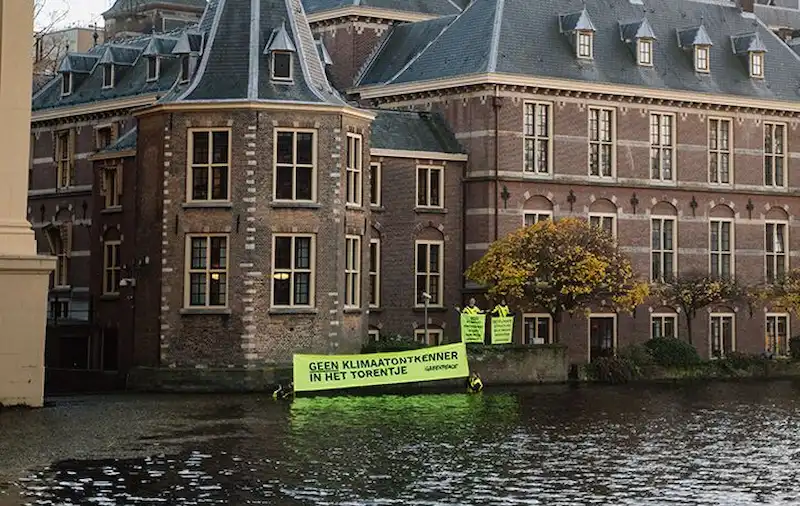
Greenpeace campaigners staged a protest in The Hague by kayaking into the pond in front of the prime minister's office. They displayed a banner calling for the rejection of "climate deniers" as the country's prime minister. Greenpeace Netherlands director Andy Palmen expressed disappointment over the election outcome, stating that it is devastating for the climate, nature, and people. He called on other parties involved in forming a government to take responsibility and address the climate crisis, emphasizing that far-right populist parties lack solutions for the challenges humanity faces.
The fragmented political landscape of the Netherlands means that Wilders would face extensive negotiations if he were to become prime minister. Notably, he has been courted by the Farmers' Citizen Movement, indicating a potential collaboration. The party, which gained seven seats in the lower house of parliament, grew in influence as it became the largest party in the upper house. With tensions already high between the government and farmers over environmental regulations, support for climate measures is expected to wane in the new parliament.
Prof. Kees Aarts of Groningen University warns that the implementation of climate measures may be delayed, posing significant risks. This development is seen as extremely detrimental to the country's climate goals. As far-right ideologies gain momentum across Europe, the Netherlands' shift in position could hinder progress and complicate the wider European push for climate action.