


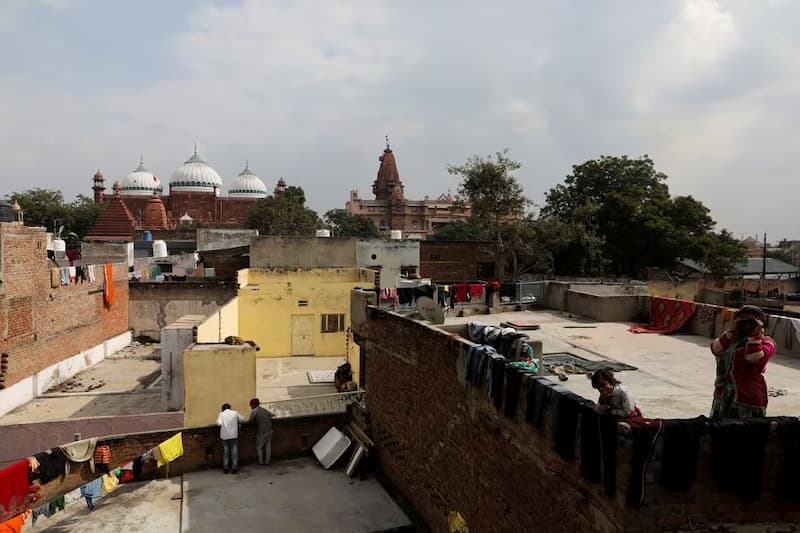


In a noteworthy development, an Indian court has granted permission to conduct a survey of a centuries-old mosque to determine if it contains any Hindu relics and symbols. The Shahi Eidgah mosque, located in Mathura city in the northern Indian state of Uttar Pradesh, is believed to sit on the birthplace of Lord Krishna, a highly revered figure in Hinduism. The decision comes as a boost to Hindu groups who claim that the mosque was built on the site of a destroyed Hindu temple.
The Allahabad High Court, on Thursday, permitted the survey of the 17th century mosque, where Muslims continue to offer prayers, in order to ascertain if there are any relics or Hindu symbols within the complex. Vishnu Jain, a lawyer representing the Hindu side, shared his belief that the Shahi Eidgah Masjid harbored signs and symbols of a Hindu temple. Last year, Hindu groups petitioned to prevent Muslims from praying in the mosque, citing concerns that Hindu artifacts inside could be removed.
Vinod Bansal, a spokesperson for the Vishwa Hindu Parishad (VHP), a hardline Hindu organization, expressed optimism about the impending revelation of truth. He stated, "The truth will come out now, was it a mosque or a temple." This move follows a similar survey conducted earlier this year on the centuries-old Gyanvyapi mosque in Varanasi, Prime Minister Narendra Modi's constituency, to determine whether it had been constructed on top of a Hindu temple.
Often aligned with Modi's nationalist Bharatiya Janata Party (BJP), members of hardline Hindu groups harbor a belief that Hindu temples were destroyed by Islamic invaders and rulers over the centuries. They seek to reclaim and restore revered temples, including those in Mathura and Varanasi. These contentious disputes place them in direct opposition to India's 200 million minority Muslim population.
The dispute in Ayodhya serves as a pertinent example, wherein Hindu mobs demolished the Babri mosque in 1992, claiming it was built on the birthplace of Lord Ram. In 2019, the Supreme Court awarded the site to Hindu groups, and next month, Modi is scheduled to inaugurate a grand Ram temple there. Responding to the recent court order, there has been no immediate reaction from Muslim groups involved.
Asaduddin Owaisi, a prominent Muslim lawmaker, stated that the Mathura dispute had been resolved decades ago but has recently been revived by a new group. He criticized this group for manipulating the law and judicial process, asserting that their sole objective is to strip Muslims of their dignity. The dispute over the historical and religious significance of the Shahi Eidgah mosque illuminates the ongoing complexities and sensitivities surrounding communal and interfaith relationships in India.