


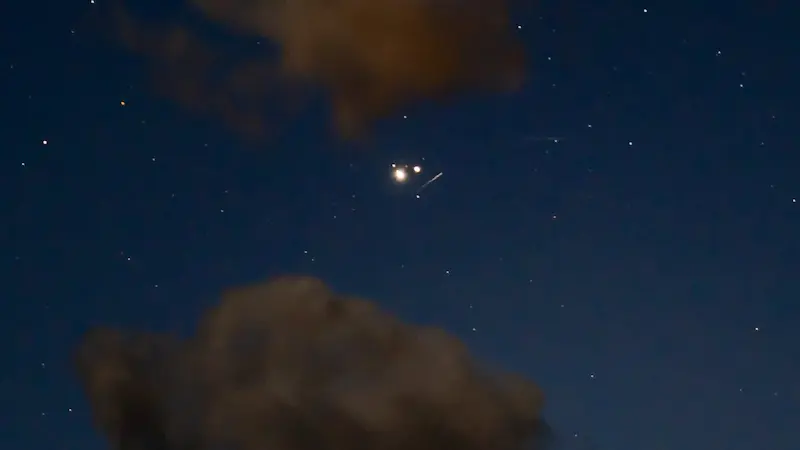


Embrace the holiday season with a breathtaking celestial display as the Ursids meteor shower graces the night sky. This phenomenal event marks the final meteor shower of 2023. According to the American Meteor Society, the Ursids will peak on Thursday night and continue into the early hours of Friday. Brave night owls, undeterred by the cold, may witness a dazzling show featuring around five to 10 meteors per hour.
This year, the Ursids will reach their zenith on the same evening as the winter solstice, which symbolizes the longest night of the year for those living in the Northern Hemisphere. As the solstice takes place, the sun will be at its farthest southern position at 10:27 p.m. ET, a tidbit shared by EarthSky. These intersecting astronomical events add an extra touch of enchantment to the meteor shower experience.
To optimize meteor viewing, sky-gazers are encouraged to wait until after the moon sets, which is around 3 a.m. to dawn local time on Friday. The moon will be 74% full on the night of the peak, potentially hindering visibility due to its luminosity. However, once it subsides, viewers can fully immerse themselves in the cosmic spectacle offered by the Ursids.
The Ursids are most visible to observers located in the Northern Hemisphere, with those in Alaska and Northern Canada experiencing the best vantage points. The radiant constellation, the point from which the meteors appear to originate, will be situated higher in the sky for these regions earlier in the night. Therefore, those positioned further north will be treated to an even more captivating show.
Unlike the Geminids, which provide ample meteor sightings in the days leading up to and following the peak, the Ursids exhibit a shorter period of maximum activity. The rate of five to 10 meteors per hour will only be observed during the peak night and early morning hours. Around the peak period, the Ursids will manifest approximately one meteor per hour. This particular meteor shower commenced in mid-December and will remain active until December 24.
Robert Lunsford, the fireball report coordinator for the American Meteor Society, stresses that while past Ursids have occasionally delivered meteor outbursts of 25 to 30 per hour, such magnificence is not expected this year. However, he adds with anticipation, "You never know." Anyone who missed the exhilarating Geminids meteor shower now has the opportunity to partake in this celestial spectacle before bidding farewell to 2023.
No sophisticated equipment is necessary to witness the meteor shower. NASA advises against using telescopes or binoculars due to their limited field of view, as meteors can be observed throughout the entire sky. The naked eye is the most effective means of absorbing the awe-inspiring Ursids meteor shower.
The Ursids meteor shower is unique among annual meteor showers as its radiant does not align with a zodiac constellation. Instead, the Ursids seem to emanate from the constellation Ursa Minor, commonly referred to as the Little Dipper. By meticulously recording the time, magnitude, and other properties of meteor sightings, researchers gain valuable insights into the debris clouds within Earth's orbital path. This data allows them to understand the density of these celestial fragments and the time it takes for the planet to traverse them.
Considering that the Ursids receive less observation than prominent meteor showers like the Geminids, the information gathered from these sightings becomes even more valuable for researchers. Even casual sky-gazers have the opportunity to contribute to this data collection effort by reporting their meteor sightings to the American Meteor Society through their website.
As the Ursids conclude the annual celestial events for 2023, stargazers can rest assured that the new year is on the horizon—with the Quadrantids meteor shower set to dazzle the sky on the morning of January 4, 2024. So, make sure to grab a warm beverage, bundle up, and marvel at the wonders that the cosmos has in store.