


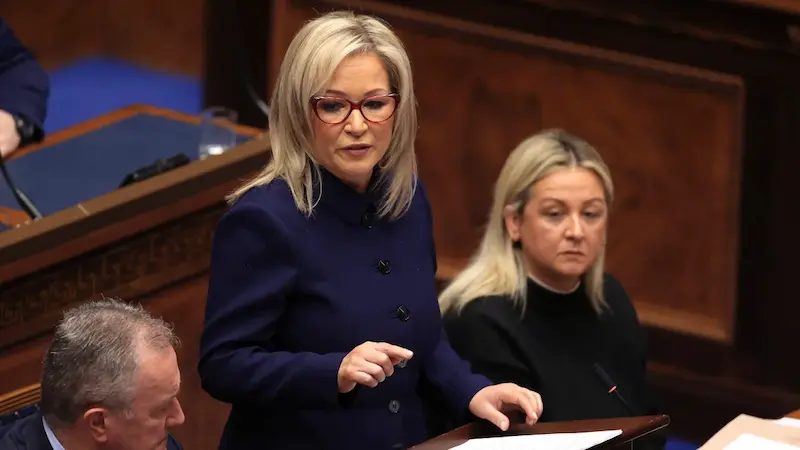


In a historic turn of events, Michelle O’Neill, a nationalist politician from the pro-united Ireland party Sinn Féin, has become the First Minister of Northern Ireland as power-sharing resumes after a two-year break. O’Neill, a former political arm of the Irish Republican Army (IRA), expressed her gratitude and optimism in her address to lawmakers following her appointment, stating, "Today opens the door to the future. I am honored to stand here as First Minister."
In an effort to foster inclusivity, O’Neill promised to serve all Northern Irish citizens equally, regardless of their British or Unionist identities. She emphasized her commitment to continuing the work of reconciliation between all communities, acknowledging that while the past cannot be changed or undone, a better future can be built together.
O’Neill has been entitled to the position of First Minister since 2022 when Sinn Féin secured a majority in the May election. However, the Democratic Unionist Party (DUP), the leading opposition party, had previously refused to enter a power-sharing government due to their concerns over post-Brexit trading rules. On Thursday, the DUP reached a deal with the UK government that addressed their Brexit concerns, thereby paving the way for the recall of lawmakers to the Northern Ireland Assembly on Saturday, ultimately bringing an end to the two-year political deadlock.
During the Assembly's recall, in addition to Michelle O’Neill's appointment, a house speaker and a Deputy First Minister were also sworn in. The latter role, which holds the same powers as the First Minister, was filled by Emma Little-Pengelly, nominated by the DUP. In her address, Little-Pengelly expressed her astonishment at the opportunity to serve Northern Ireland and recounted her childhood experience of an IRA bomb outside her home. Despite ideological differences, she emphasized the need for joint efforts in addressing issues like healthcare, stating, "Michelle is an Irish Republican, and I am a very proud Unionist... But what we can agree is that cancer doesn’t discriminate, and our hospitals need fixing."
The Good Friday Agreement of 1998, which brought an end to "The Troubles" - a decades-long period of sectarian violence between pro-republican Catholics and pro-unionist Protestants - stipulates that both communities have equal powers in government and institutions. The symbolic significance of O'Neill's appointment as First Minister, as highlighted by Irish political commentator Fintan O'Toole, is evident in Northern Ireland, where symbols hold significant weight. O'Toole suggests that with the rise of Sinn Féin and O'Neill's assumption of leadership, the future of Northern Ireland is far from certain. While a United Ireland may not be an immediate prospect, the event marks a significant moment that challenges the foundation of Northern Ireland as a Protestant-majority region committed to remaining within the United Kingdom.
The primary role of the Northern Ireland Assembly, as a devolved legislature, is to legislate over issues not explicitly under the jurisdiction of the Westminster government in London. The renewed power-sharing agreement and the appointment of Michelle O’Neill as the First Minister signal a significant step towards building a more inclusive and united future for Northern Ireland, one that is full of opportunity and promise rather than fear and division.