


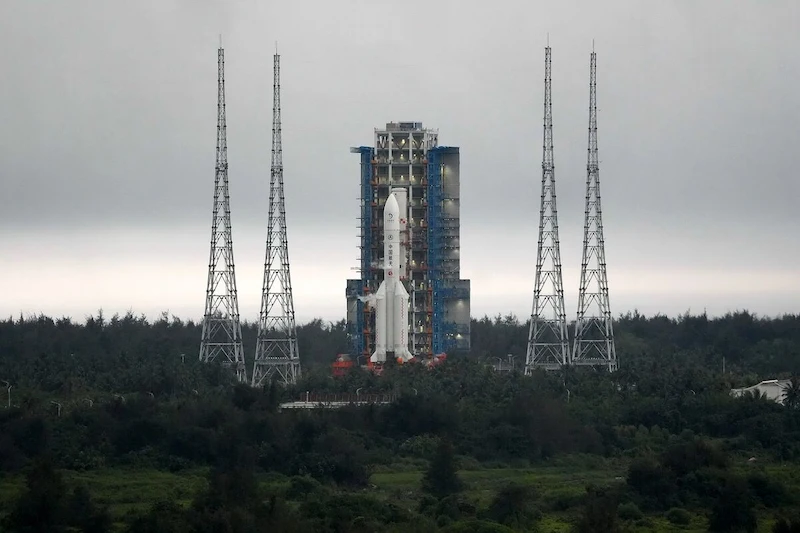


In a significant milestone for China's space exploration endeavors, the Chang'e-6 spacecraft has made a successful touchdown on the far side of the moon, marking a crucial step in the country's ambitious lunar exploration program. The China National Space Administration confirmed the spacecraft's safe landing at the designated area, as reported by Xinhua News Agency on Sunday.
Chang'e-6 aims to achieve a historic feat by being the first mission to collect samples from the unexplored far side of the moon and return them to Earth. This mission follows the Chang'e-4 spacecraft, which touched down on the far side in 2019, making China the first nation to achieve a soft landing in that challenging region, known for its communication difficulties due to its lack of direct line of sight to Earth.
Within the next 48 hours after landing, Chang'e-6 is set to commence drilling beneath the lunar surface and employ a robotic arm to gather surface materials for analysis. The chosen landing site, an impact crater within the South Pole-Aitken Basin known as the Apollo Basin, holds significant scientific interest due to its potential water ice resources, key for sustaining human presence on the moon by producing oxygen and rocket fuel.
This mission, which lifted off on May 6, is slated to span approximately 53 days, during which crucial scientific data and samples will be collected. Zeng Xingguo, a scientist at the National Astronomical Observatories of the Chinese Academy of Sciences, emphasized the importance of acquiring direct samples from the moon's far side to deepen our understanding of its unique characteristics and unlock its mysteries.
The Chang'e-6 mission is part of China's broader lunar exploration strategy, aiming to pave the way for Chinese astronauts to set foot on the moon by the end of the decade. This aspiration aligns with the U.S.'s Artemis program, which targets a manned lunar landing near the moon's south pole by 2026, marking a new chapter in human space exploration.
Notably, the Chang'e-6 landing coincided with Russia's endorsement of a collaborative agreement with China to develop the International Lunar Research Station near the lunar south pole. This joint effort underscores the growing strategic partnership between the two nations in space exploration and cements Russia's prominent role in lunar research and utilization endeavors, signaling a new era of international cooperation in lunar exploration.