


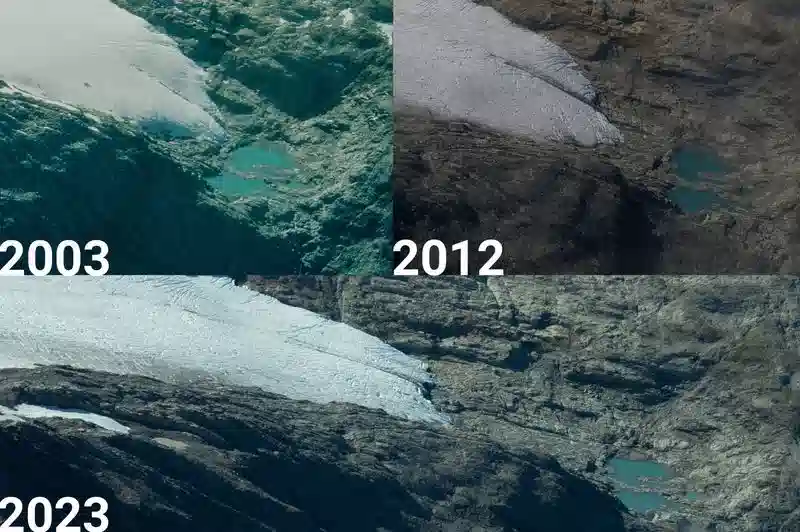


New Zealand's Southern Alps glaciers are rapidly retreating due to climate change and an unusually hot summer, according to an annual scientific survey conducted by the National Institute of Water and Atmospheric Research. The aerial survey, which has been conducted since 1977 with the help of Victoria University of Wellington and the Department of Conservation, reveals that the country's glaciers are shrinking at a concerning rate, with very little snow and ice expected to remain in the Southern Alps. The survey involves hours of aerial photography of southern glaciers used to create 3D models that compare snow and ice from year to year. Andrew Mackintosh, head of the School of Earth, Atmosphere, and Environment at Melbourne's Monash University, described the scale of retreat as "confronting," emphasizing the urgent need to slow down climate change.
New Zealand's Fox and Franz Joseph glaciers, which have attracted tourists and explorers for decades, are retreating at an alarming pace, according to an annual scientific survey by the National Institute of Water and Atmospheric Research. The glaciers are continuing to shrink due to climate change and an unusually hot summer. The survey, which requires hours of aerial photography of southern glaciers, is used to build three-dimensional models comparing snow and ice from year to year. Scientists warn that if current trends continue, the nation's Southern Alps will have very little snow and ice coverage. The loss of these natural wonders will not only affect the livelihoods of those who rely on tourism, but also jeopardize New Zealand's intimate relationship with them. Over the past four decades, more than 30% of the ice volume of the Southern Alps has been lost, and reversing the trend will take centuries.