


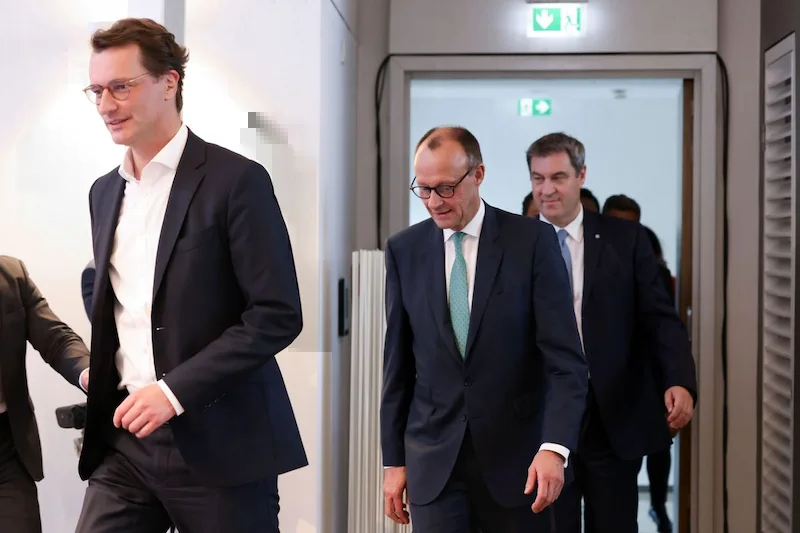


With Germany's next national election approaching in 2025, the discussion about who will be the opposition conservatives' candidate to challenge Chancellor Olaf Scholz is gaining momentum. While Friedrich Merz, Chairman of the Christian Democrats, is often expected to be the obvious choice for the CDU/CSU alliance, his reputation as a relic of the right-wing old-boys' club is alienating younger voters. This has brought attention to Hendrik Wuest, the Premier of North Rhine-Westphalia, who is seen as a new and likable face that could potentially take the conservative party in a different direction.
Despite his relative inexperience at the federal level, Wuest has garnered praise for comfortably securing the traditionally Social Democratic stronghold in a state election last year. Notably, he currently governs in a coalition with the Greens, which provides him with an opportunity to appeal to younger voter groups. If the conservatives were to reclaim the federal chancellery, they would likely need to form a coalition with the Greens, making Wuest's alliance with them a valuable asset.
However, Wuest has not publicly commented on whether he is considering a run for the candidacy. To convince members of the CDU/CSU bloc that he is the best candidate to challenge Scholz, he would face challenges, especially due to Friedrich Merz's strong base among grass-roots members. Moreover, Merz's recent remarks appearing open to cooperation with the far-right AfD have further damaged his popularity among German voters.
Apart from Merz and Wuest, Markus Soeder, the Chairman of the CSU and Premier of Bavaria, also has a genuine chance to secure the candidacy. Soeder made a strong bid for the candidacy in the 2021 election but was ultimately thwarted by Armin Laschet, Wuest's predecessor in North Rhine-Westphalia. The conservatives will be keen to avoid a repeat of the damaging dispute that ensued.
Recent polls suggest that Soeder is favored by a significant portion of the German public, with 29% believing he has the best chance of winning the next election for the conservative alliance. Wuest scored 18% in the same poll, while Merz garnered 13%. Another poll revealed that 69% of respondents did not believe Merz is equipped to lead Germany's largest economy.
The outcome of the regional elections in Bavaria and Hesse on October 8 is likely to influence the race for the candidacy. Poor results for the conservatives could harm the prospects of both Soeder and Merz while potentially boosting aspiring candidates like Wuest.
Wuest's position as the Premier of North Rhine-Westphalia puts him in a favorable position for a national run. Leading the state is seen as excellent preparation for the chancellor's office, given the shared challenges faced by both the state and the country at large, such as the changing industrial landscape, bridging the urban-rural divide, infrastructure issues, and demographic changes.
However, Wuest's past may also come under scrutiny, as he was previously viewed as a more hardline figure during his time as secretary general of the regional party. Nevertheless, Wuest seems to have embraced the need for openness and modernity in German politics, recognizing that coalition building requires adaptability.
During a recent wind farm visit with Wuest, Chancellor Scholz humorously deflected questions about his potential challengers, stating that he is not the spokesperson for the CDU and advising to seek answers from them in Berlin.
In the race to challenge Chancellor Scholz, Hendrik Wuest emerges as a fresh and likable conservative politician, with his alliance with the Greens in North Rhine-Westphalia providing him a strategic advantage. However, he will need to overcome the popularity of Friedrich Merz and Markus Soeder to secure the candidacy. As the regional elections near, the outcome could significantly impact the dynamics of the race.