


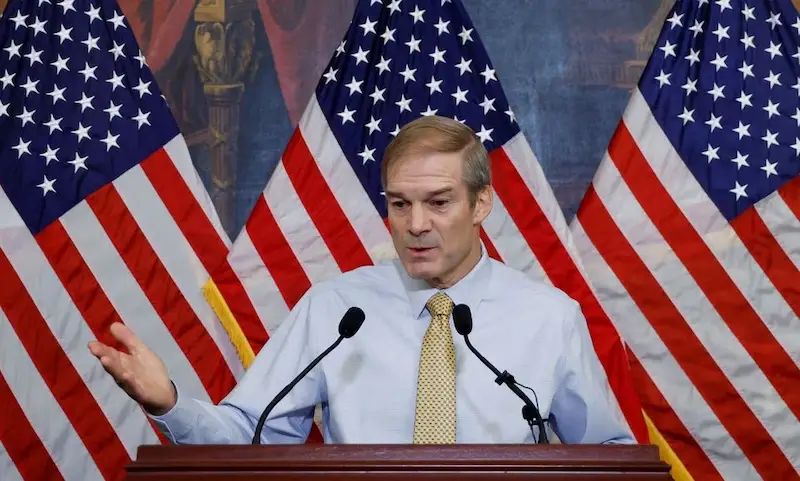


Jim Jordan, the hardline conservative Republican, has lost support in his quest to become the speaker of the U.S. House of Representatives. After a third failed vote on the House floor, several lawmakers revealed that they have revoked their endorsement of Jordan. This secret-ballot vote leaves the chamber leaderless and unable to respond to President Joe Biden's requests for aid to Ukraine and Israel until next week at the earliest.
Support for Jordan's candidacy has steadily declined throughout the week. In the most recent round of balloting on Friday, he received only 194 votes, down from the 200 votes he received on Tuesday and far below the majority required to claim the speaker's gavel. In a closed-door meeting, Republicans then voted 112-86 to withdraw Jordan's nomination.
In a statement to reporters after the meeting, Jordan expressed his honor at being designated as the speaker but acknowledged the need for Republicans to come together to decide on a new leader. He affirmed his commitment to supporting the chosen individual. The next step remains uncertain, as Republicans must now return to the drawing board to find a viable candidate.
With the House ending its third week without a leader, crucial matters such as President Biden's $106 billion national-security package, designed to strengthen U.S. border security while providing support to Ukraine and Israel, remain unaddressed. The narrow Republican majority in the House, with just a 221-212 margin, means that the party cannot afford many defections on party-line votes.
Apart from Jordan, Republicans have also rejected Steve Scalise, their No. 2, who won the nomination last week but stepped down when he was unable to consolidate support. This leaves the party in search of a candidate who can rally enough votes to secure the position of speaker.
Candidates will have the opportunity to present their case on Monday evening, with a potential vote scheduled for Tuesday. Austin Scott and Kevin Hern have confirmed their intention to pursue the position, while Jodey Arrington will make a decision by Sunday. However, the party has already rejected a backup option that would allow the House to address pressing matters through temporary leadership under Representative Patrick McHenry.
Jordan's candidacy faced opposition due to his close alliance with Donald Trump and his involvement in attempts to overturn Biden's 2020 election victory. Republicans critical of Jordan cited his uncompromising approach and his role in government shutdowns as a cause for concern. Additionally, they expressed frustration over intimidating phone calls and death threats associated with his campaign.
Despite these concerns, Jordan's allies argued that receiving death threats is unfortunately common for lawmakers and should not be a disqualifying factor. However, 25 Republican legislators voted against him in Friday's vote, compared to the 20 who opposed him on Tuesday. Jordan's final vote tally of 194 falls short of the support McCarthy gained during his demanding 15-round voting process in January.
Democrats uniformly voted against Jordan in all three floor votes, viewing him as a dangerous extremist. Representative Katherine Clark emphasized that his vision directly challenges the freedom and rights of the American people. Nonetheless, Jordan's Republican opponents refrained from celebrating his defeat.
The immediate focus for Republicans is now the collective effort to elect a speaker who can garner the support of the conference. While the path ahead remains uncertain, the urgency to fill this leadership vacuum and address critical issues facing the House persists.