


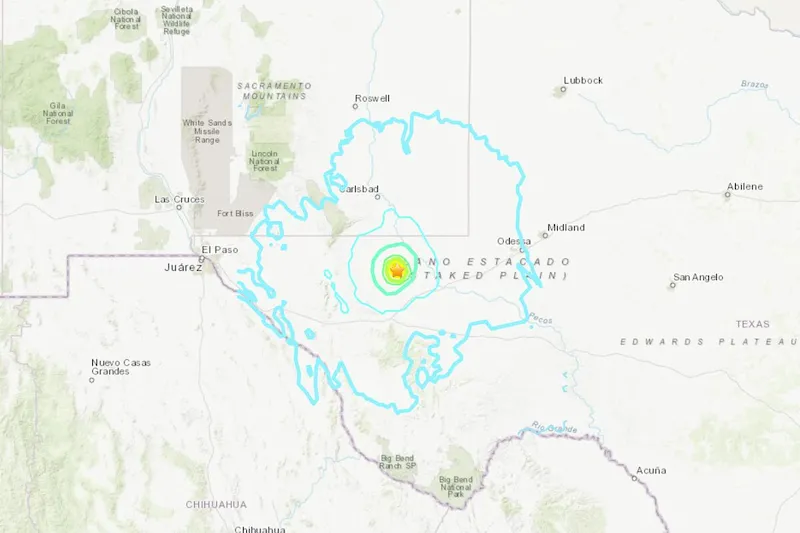


In the early hours of Wednesday, an earthquake shook West Texas oil country, marking the state's second-largest tremor on record. The 5.3 magnitude quake occurred at 4:27 a.m. local time, striking approximately 24 miles south of Mentone, Texas, according to the US Geological Survey. Interestingly, this earthquake was slightly less powerful than a similar event that occurred almost a year ago in the same region. Just one month after last year's record-breaking earthquake, the area experienced yet another significant tremor measuring 5.2 magnitude, as reported by the Texas Seismological Network.
The Permian Basin, North America's most productive shale field, has been facing a growing challenge in finding suitable locations to dispose of the vast amounts of toxic saltwater that accompanies crude oil production. Historically, oil companies have relied on disposal wells in the Permian to store wastewater. However, these wells have been linked to seismic activity and are currently experiencing increased pressure buildup. As a result, the capacity of these wells to handle additional water has become limited, according to B3 Insight, a provider of industry data.
Over the past few months, Texas has witnessed a surge in significant earthquakes across various regions, as noted by Scott Tinker, the state's leading geologist and director of the Bureau of Economic Geology at the University of Texas. Tinker emphasizes the importance of ongoing research and mitigation efforts in light of this heightened seismic activity.
Recognizing the implications of the situation, the Texas Railroad Commission, responsible for regulating drilling in the largest oil-producing state in the US, announced cuts to water disposal in certain areas in December, following last year's record-breaking earthquake. For the industry, this issue is critical as shale producers require adequate means to dispose of wastewater that can be up to ten times saltier than seawater. Without viable disposal options, oil companies face challenges in drilling new wells.
The recent earthquake in West Texas serves as a reminder of the evolving landscape in the oil industry. As seismic activity increases and disposal well capacities reach their limits, it becomes imperative to find innovative solutions for wastewater management. The industry must adapt and explore alternative methods to safely and efficiently dispose of the saltwater byproduct generated during oil production. Moreover, continued research and mitigation efforts are necessary to better understand the relationship between wastewater disposal and seismic activity, fostering sustainable practices in oil-producing regions like West Texas.