


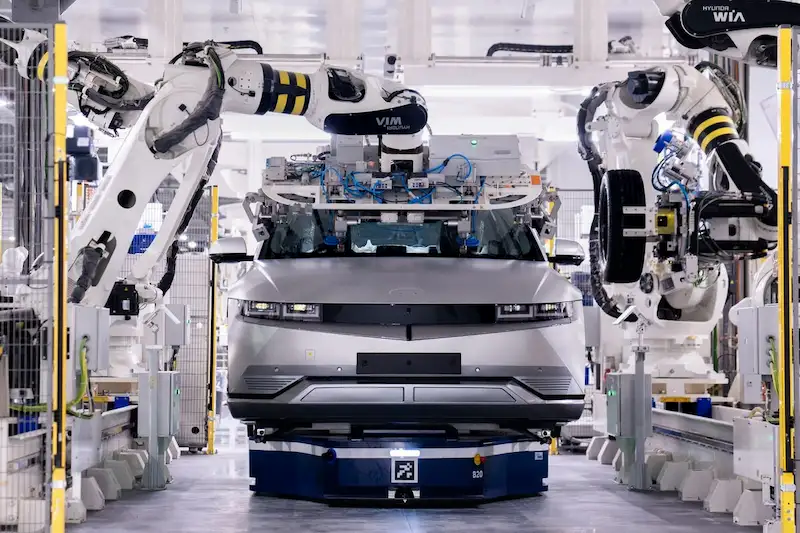


Hyundai Motor Group has officially inaugurated its state-of-the-art facility, the Hyundai Motor Group Innovation Center Singapore (HMGICS), which is expected to play a crucial role in the company's electrification strategy in the coming decades. The seven-story facility, spanning 86,900 square meters, is equipped with advanced robotics and innovative production methods. It has been operational since the beginning of this year, producing Ioniq 5 electric vehicles and fully autonomous robotaxis. The manufacturing lineup will expand to include the Ioniq 6 in 2024.
The HMGICS aims to become one of Hyundai Motor Group's two key innovation pillars, leading the company into the electrification era over the next 50 years. This facility will serve as a testbed for developing future mobility solutions. As a symbolic gesture, an Ioniq 5 is prominently displayed in the building's lobby alongside Hyundai's first-ever car, the Pony, which played a significant role in the establishment of South Korea's automobile industry in the 1970s.
The standout feature of the facility is its cell-based production system, where humans and robots work in tandem, replacing the conventional conveyor-belt approach. Approximately 200 robots are engaged in various operations, such as assembly and inspection, allowing human employees to focus on more creative and productive tasks. This innovative approach enhances efficiency and productivity within the manufacturing process.
Singapore Prime Minister Lee Hsien Loong attended the groundbreaking ceremony for the center three years ago and hailed it as a major milestone for Hyundai and the first of its kind worldwide. He expressed hope that this facility would attract more investment from South Korean companies. Additionally, the building boasts a 618-meter test driving track on the rooftop, offering a unique testing ground for Hyundai's vehicles. A smart farm is also incorporated into the facility, where robots work to produce vegetables. Some of the harvested vegetables will be utilized in an upcoming restaurant set to open next year.
Singapore has dedicated only 1% of its land to agriculture, and the small city-state currently imports 90% of its consumed food. To address this concern, Singapore aims to locally produce 30% of its food by 2030. The smart farm within HMGICS aligns with this goal, showcasing Hyundai's commitment to sustainable practices and contributing to Singapore's food security initiatives.
Hyundai Motor Group, which includes Hyundai Motor Co., Kia Corp., and the luxury Genesis brand, aims to produce over 3.6 million electric vehicles annually by the end of the decade. To support these ambitious goals, the conglomerate is building a larger factory in Ulsan, South Korea, with a capacity of producing 200,000 EVs per year. Furthermore, Hyundai plans to establish another factory in the US state of Georgia, capable of manufacturing 300,000 EVs annually.
The Hyundai Motor Group Innovation Center Singapore represents more than just a factory; it serves as a platform for experimenting with an entire business model. By harnessing automation, robotics, and advanced production techniques, Hyundai is paving the way for the future of electric vehicle manufacturing, demonstrating its commitment to innovation and sustainable mobility solutions.