


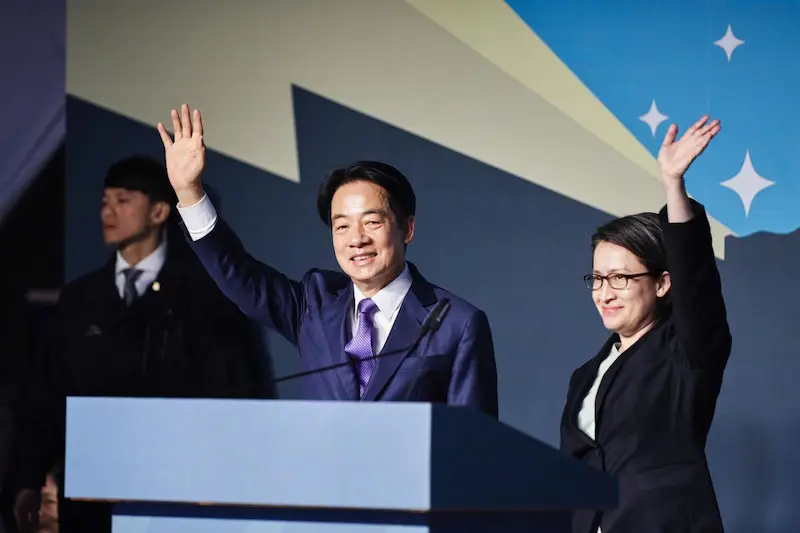


In a closely watched election, Taiwan has elected Lai Ching-te, a member of the ruling Democratic Progressive Party, as its president. The victory of Lai, who is considered an "instigator of war" by Beijing, in the island's most hotly contested election in years has significant implications for the ongoing tensions between the United States and China. Lai sealed the victory with 40.1% of the vote, the lowest winning percentage since the year 2000. Lai's win sends a message to the international community that Taiwan stands on the side of democracy in the face of authoritarianism.
At a victory rally in Taipei, Lai declared, "We are telling the international community that between democracy and authoritarianism, we will stand on the side of democracy." He also pledged to maintain peace across the Taiwan Strait while emphasizing Taiwan's commitment to aligning with major democracies, a clear reference to the country's ties with the United States.
China, which views Taiwan as a breakaway province that it aims to reclaim in the future, has labeled Lai a "troublemaker" and a "separatist" prior to the election. President Xi Jinping's government has not explicitly mentioned Lai in its initial responses. However, Beijing's Taiwan Affairs Office spokesperson, Chen Binhua, stated that the election result shows the ruling party does not represent mainstream public opinion on the island.
The election outcome is expected to test the stability of the recent improvement in relations between Beijing and Washington. President Joe Biden, who has pledged to defend Taiwan, stated that the United States does not support Taiwan's independence. The US Secretary of State, Antony Blinken, reiterated the US commitment to maintaining peace and stability across the Taiwan Strait.
Lai's victory speech, broadcast in English, demonstrated Taiwan's democratic strength. It is worth noting that the Democratic Progressive Party's re-election for a third consecutive term will present challenges for both Beijing and Washington, requiring efforts to avoid escalating tensions.
Despite Lai's commitment to cooperation with China, it is unlikely that his party will be able to restart dialogue with Beijing, as the Communist Party insists on Taiwan recognizing itself as part of China as a prerequisite. However, Lai has promised to support the development of Taiwan's chip industry, a crucial sector dominated by Taiwan Semiconductor Manufacturing Co., which serves as a vital component of the global supply chain of advanced technology.
While Lai's victory signals Taiwan's desire to maintain distance from China, it also reflects the population's concerns over domestic issues, such as rising property prices and slow wage growth. The election highlighted the Taiwanese people's preference to keep China at bay, even as they expressed frustration with the ruling party.
Despite the disappointment for the opposition parties, the Taiwan People's Party (TPP) and the Kuomintang (KMT) in the presidential race, they made some gains in the legislature. The TPP increased its legislative seats to eight, granting it the power to act as a kingmaker between the two main parties. The KMT also increased its seats in the legislative body, allowing it to exert more influence over government budgets and major arms purchases.
Overall, Lai's election as president of Taiwan signifies a clear rejection of China's warnings and a reaffirmation of the island's commitment to democracy and its partnership with the United States. The coming months will witness the reactions of both Beijing and Washington to this significant development in the region.