


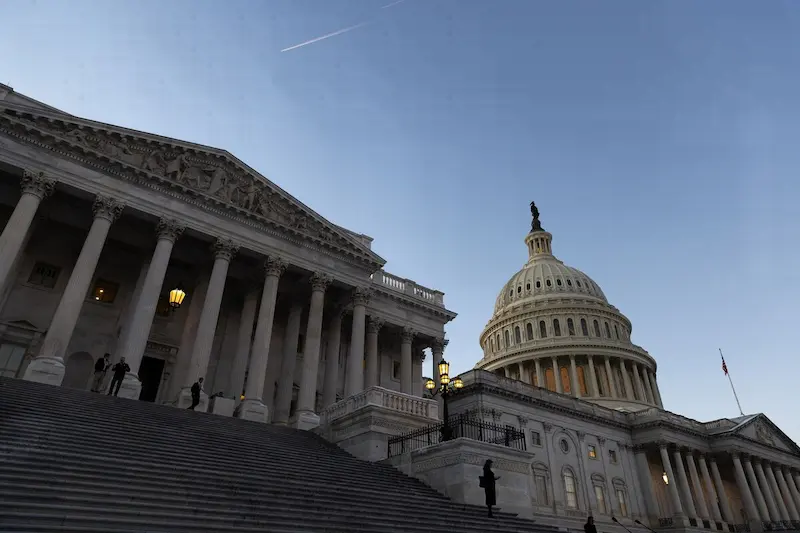


In a bid to prevent a partial government shutdown, the US Senate has successfully passed a temporary spending bill. The legislation will now move to the House, where it is expected to gain approval later today. This interim measure aims to fund various US agencies, ensuring they remain operational until either March 1 or March 8, depending on the agency's specific deadline. The Senate's overwhelming vote of 77 to 18 reflects lawmakers' urgency to leave Washington ahead of an impending snowstorm forecasted for Friday.
The House's approval appears likely due to the support of Democrats, who are ready to provide the necessary votes, despite some conservative Republicans expressing objections. Certain members of the Republican party are displeased with Speaker Mike Johnson, as he reneged on a promise made in November against further temporary funding extensions. These hardline Republicans push for utilizing the threat of a shutdown to compel President Joe Biden into accepting border policy changes. Speaker Johnson's decision to use emergency war funds for Ukraine as leverage in border discussions created an impasse on Ukraine aid.
Speaker Johnson demonstrated his refusal to be swayed by hardline Republicans within the House Freedom Caucus earlier today. They attempted to derail the interim funding proposal by adding conservative demands related to immigration policy changes. Such demands are met with strong opposition from many Democrats, and the speaker rejected the proposal outright.
While the short-term spending bill is intended to provide lawmakers with additional time to negotiate annual funding for the ongoing fiscal year that began on October 1, it remains uncertain whether the six-week extension until March 1 will be sufficient. The House is scheduled to have a break for three of those weeks, increasing the likelihood of another short-term spending bill being required.
Dick Durbin, the No. 2 Senate Democrat, voiced his concerns, stating that unless something significant occurs, it appears that another short-term spending bill will be the likely outcome. Both party leaders have already agreed on an effective spending cap of $1.66 trillion for the year. However, negotiations are still ongoing regarding the allocation of this budget among different government departments and programs. Additionally, conservative demands to attach policies like immigration and abortion restrictions to the funding bills, along with funding requests for individual legislators' pet projects, also need to be addressed.
If the government remains under interim funding until April 30, a set of automatic across-the-board spending cuts will be triggered as outlined in the debt ceiling compromise from last June. This potential threat could serve as a catalyst for lawmakers to expedite the finalization of the 2024 spending plan. Only time will tell if these negotiations will progress smoothly, or if further delays and short-term funding extensions will be necessary to avoid a government shutdown.