


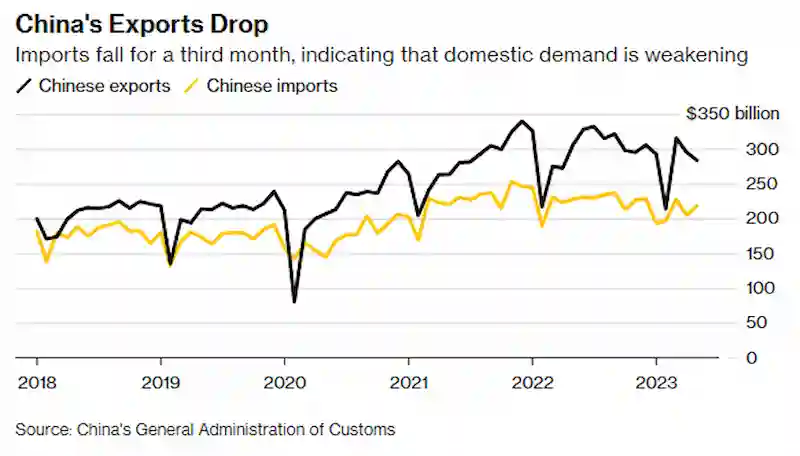


China's exports fell for the first time in three months, indicating that the risks to the country's economic growth are increasing as global demand weakens. According to official data released on Wednesday, overseas shipments shrank by 7.5% from a year ago to $284 billion, which is worse than the predicted 1.8% drop. The decline in exports has affected most destinations, with double-digit drops recorded in the US, Japan, Southeast Asia, France, and Italy. Meanwhile, imports declined by 4.5% to $218 billion, slightly better than the expected 8% drop, resulting in a trade surplus of $66 billion.
The slump in imports from Taiwan and South Korea, by more than 20%, indicates the weakness in global electronics demand. This drop in imports is significant since it poses another set of growth concerns for China's economy, which seemed to be recovering earlier this year boosted by the expansion in exports. However, recent data shows that the recovery has weakened, with manufacturing activity contracting as well as a slow growth in home sales in May when compared to the earlier months of the year.
While China's exports were looking bright in the earlier months of the year, the sharp decline in exports in May represents the effect of a slowing global economy on China. Bloomberg surveyed economists, and they predict that China's exports will contract for the full year. Many strategists, including Khoon Goh of Australia & New Zealand Banking Group, believe that Wednesday's trade report will "raise growth concerns and intensify expectations of more policy support." Speculations concerning Beijing's delivery of more stimulus to bolster growth are growing, with economists predicting that the central bank might cut the reserve requirement ratio for banks or opt for an interest rate cut.
In spite of the above, one bright spot for Chinese exporters is the continued strength of global demand for Chinese cars, with total vehicle shipments breaking the record for the highest vehicle shipments of $9 billion in a single month. The growing popularity of Chinese electric vehicles overseas remains one of the drivers of the surge in car exports. The government has already set a growth target of around 5% for the year, which most economists expect will be achieved despite the recent slump in activity, thanks to the growth in consumer spending on tourism and restaurants. However, the recent data indicates that industrial activity has lagged, prompting calls for policy support to address the slump.