


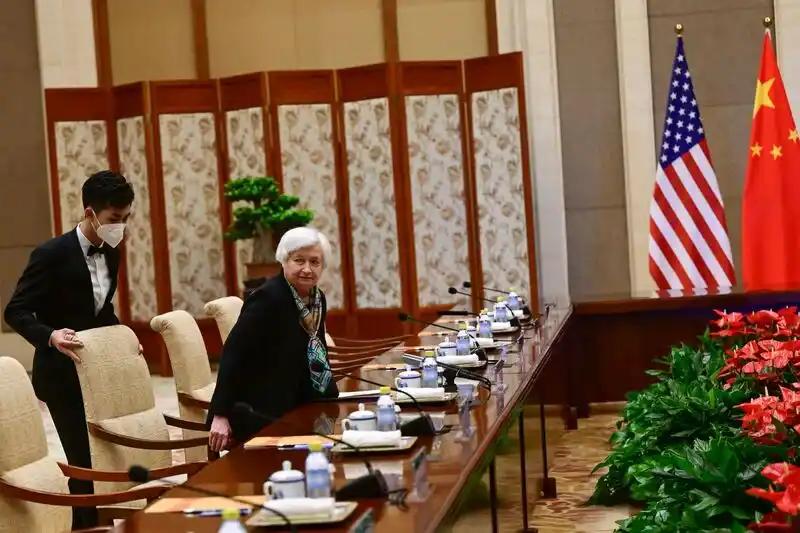


A group of Chinese female economists and entrepreneurs who recently dined with Treasury Secretary Janet Yellen have found themselves at the center of controversy and online backlash. The women, who were criticized for interacting with a US official, have been accused by online nationalists of betraying their country.
The Treasury department did not disclose the names of the attendees at the meeting held on Saturday. However, a group photograph of the gathering was shared on China's social media platform, Weibo, leading to the identification of some participants. One of the most vocal critics was Shen Yi, a professor in international politics at Fudan University, who suggested that the women would be expected to deliver certain outcomes in exchange for the meal.
The criticism primarily targeted two women who shared their experience on social media. Liu Qian, the Economist Group's managing director for Greater China, and author Hao Jingfang, who previously worked for the China Development Research Foundation, faced the brunt of the negative comments. In response to a question about why she attended the dinner, Hao stated that Yellen was known for being friendly and committed to developing friendly relations between China and the US. However, some accused her of being an "American spy."
Another criticism aimed at the women was their privileged status and lack of experience in factory work. A comment with over 600 responses highlighted the elite backgrounds of the selected attendees and their detachment from the struggles faced by ordinary workers.
Yellen's decision to engage with women economists and entrepreneurs during her trip to Beijing emphasizes the importance she places on female representation in elite decision-making. While the Chinese government only provided male officials to meet Yellen, she took the opportunity to address the issue of gender disparity and the underrepresentation of women in leadership roles. This move comes at a time when President Xi Jinping excluded women from China's top leadership in last year's congress and promotes traditional caregiving roles for women amid the country's declining birth rate.
This backlash against the women parallels previous attacks launched by online nationalists against foreign female journalists of ethnic Chinese origin working for Western news organizations. It includes derogatory comments, crude sexual innuendos, and even threats of physical violence.
The Treasury, in response to the backlash, highlighted the importance of women's participation in the workforce and their contributions to economics. They emphasized that women's perspectives are crucial for ensuring that economic research and policymaking accurately reflect society's priorities.
In conclusion, the meeting between Yellen and Chinese women economists and entrepreneurs has stirred up controversy and led to accusations of betrayal and espionage. The incident sheds light on the ongoing challenges faced by women in positions of power in both China and the international arena.