


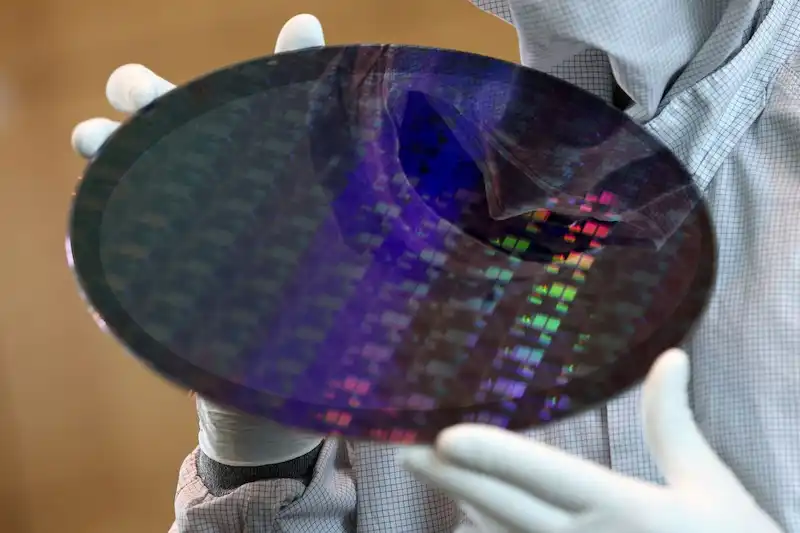


The German government, under Chancellor Olaf Scholz, has announced plans to allocate €20 billion ($22 billion) in funding to bolster semiconductor manufacturing in the country. The move aims to support the tech sector and secure critical component supplies as geopolitical tensions continue to rise.
The funds, drawn from the Climate and Transformation Fund (KTF), will be distributed to both German and international companies by 2027. Initially established for investments in decarbonization efforts, the KTF's scope has been expanded to address Germany's need to boost its tech industry. The government is currently negotiating the allocation of up to €180 billion, which will be published in the coming weeks.
With economic uncertainty, persistent inflation, and the impact of the US's Inflation Reduction Act, European countries have been under pressure to attract investments. Germany has already agreed to provide €10 billion in aid for a new Intel Corp. plant and is in the process of finalizing around €7 billion in subsidies for companies including Taiwan Semiconductor Manufacturing Co. (TSMC) and Infineon Technologies AG.
The plan to support chip manufacturing means that at least €3 billion will be available for additional projects, which could benefit other companies operating in Germany. GlobalFoundries Inc. has a significant presence in Dresden, while German supplier Robert Bosch GmbH also runs a chip plant in the city.
The decision to allocate funds for semiconductor manufacturing comes as Europe becomes more aware of its dependence on Asian supplies, particularly in the wake of disruptions caused by the pandemic and tensions resulting from the war in Ukraine. In its recently released China strategy, the German government pledged to reduce dependence by diversifying and attracting future technologies, such as semiconductors.
The shortage of chip supplies during the COVID-19 pandemic highlighted the need to expand local semiconductor production for German automakers and other manufacturers. Trade conflicts between the US and China have further emphasized the risks of relying heavily on overseas supply chains. However, it should be noted that the majority of the allocated funds will go to non-European companies.
Intel, the US chipmaker, will receive half of the funding with €10 billion earmarked for its production site in Magdeburg, Germany. This constitutes about a third of the total investment in the facility. Meanwhile, the German government is in the final stages of negotiations with TSMC, the world's largest contract chipmaker, to invest in a plant in Dresden. Up to €5 billion in subsidies, approximately half of the total investment, has already been budgeted for this project.
Infineon, a German semiconductor manufacturer, will receive €1 billion, accounting for approximately 20% of the investment in a new semiconductor fab in Dresden. Additionally, German automotive supplier ZF Friedrichshafen AG and US chipmaker Wolfspeed Inc. will receive state funds to build a factory for silicon carbide chip production in Saarland, near the French border. The joint venture is seeking subsidies for about 25% of the costs, totaling around €750 million.
Other funding will be provided through the European Union's program to invest in green and digital transition as well as other key technologies, known as IPCEI projects.
Despite Germany's return to fiscal constraint, with planned budget cuts and a focus on adhering to constitutional debt limits, the government is committed to subsidizing companies in order to strengthen the country's semiconductor industry. While the €20 billion package falls short of the $50 billion provided by the US through the Chips and Science Act, it still surpasses the subsidy amounts promised by other major governments. Japan is prepared to commit over $14 billion, while India is offering $10 billion to attract investment.