


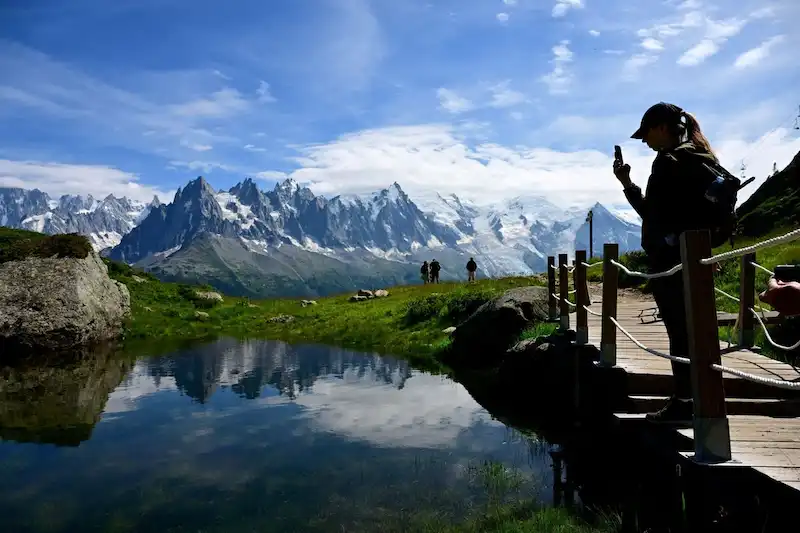


An unprecedented heatwave is wreaking havoc on the Alps, with freezing levels rising even higher than the mountaintop glaciers. On Monday, temperatures soared so high that the freezing point reached above 5,000 meters (16,400 feet), surpassing the height of the glacial peaks found in the Alps. This means that, for now, the entire range is below the freezing level. Climatologist Claudio Tei from the Italian National Research Council reported these alarming findings.
The Aletsch Glacier, standing at just over 4,000 meters, is the largest glacier in the Alps. However, even this colossal ice formation is currently enclosed within the above-freezing temperatures. Mont Blanc, the highest peak in the region, measuring slightly over 4,800 meters, also falls within this unfortunate predicament.
Over the past few nights, the temperatures across the Alps have failed to drop below zero, according to Tei. Even at the highest point of Monte Rosa in Italy, the Capanna Margherita at 4,554 meters, the temperature never fell below 1.5 degrees Celsius (34.7 degrees Fahrenheit) on Monday night.
Areas of Switzerland, usually known for their relatively mild climate, are experiencing near-tropical temperatures in the evenings. In Vevey, situated on the shores of Lake Geneva, the temperatures have remained above 25.4 degrees, which is typically considered a normal daytime reading during summer, according to the weather service Meteonews.
Tragically, just days ago, a mountaineer lost their life after a collapse on the Fee Glacier, caused by the extreme conditions. It is a somber reminder of the dangers posed by these soaring temperatures. Last year, a glacial collapse in the northern Italian Alps claimed the lives of 11 people, further underscoring the severity of the situation.
Studies conducted by Tei indicate that heatwaves have become increasingly common since the late 2000s. These findings are based on data collected from the Payerne weather station in Switzerland, spanning back to 1954. The current severe heatwave affecting northern Italy, Switzerland, and France is attributed to the expansion of the subtropical anticyclone. This weather pattern, typically more prevalent in central and southern Italy, has now extended its influence to the Alpine region, exacerbating the already alarming situation.
The impacts of this heatwave on the Alps and its glaciers are deeply concerning. As temperatures continue to rise and freezing levels surpass even the highest points of the mountains, it is crucial to address the underlying causes of this phenomenon. Mitigating climate change and adopting sustainable practices are essential steps in averting further damage to these majestic and vital natural environments.