


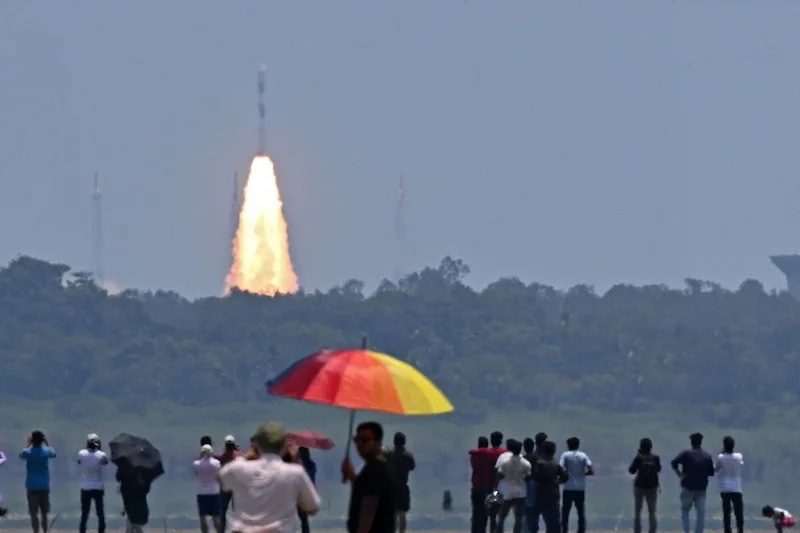


India has achieved yet another milestone in its space program with the launch of its first solar observation mission, Aditya-L1. Following the successful moon landing just weeks ago, this mission further establishes India's position in the global space race. The spacecraft blasted off from Sriharikota, the country's main spaceport located on an island off the coast of Andhra Pradesh, at 11:50 a.m. local time on Saturday.
Aditya-L1 embarks on a 125-day journey to reach its destination, which is approximately 1.5 million kilometers (932,000 miles) away from Earth. While this distance is only a fraction of the 150 million km gap between Earth and the sun, it is still a significant undertaking. The mission aims to study the sun's workings and observe its impact on environmental conditions near Earth and other celestial bodies.
India's space agency, ISRO, has been making remarkable strides in recent years. Alongside this solar mission, ISRO is working on a human spaceflight program that aims to launch astronauts into orbit for the first time, potentially by 2025. The agency also has plans to cooperate with NASA on sending astronauts to the International Space Station, and discussions with Japan are underway for a joint moon mission. Prime Minister Narendra Modi has even revealed plans for an uncrewed Venus mission.
With Aditya-L1, India joins a select group of countries that have sent missions to study the sun. China currently has two spacecraft orbiting Earth for this purpose, including the Advanced Space-based Solar Observatory. Hinode, a joint endeavor by space agencies from Japan, the UK, the US, and Europe, is also actively measuring magnetic fields of the sun. Additionally, the Solar & Heliospheric Observatory mission, a collaboration between NASA and the European Space Agency, is stationed near the Lagrange point that Aditya-L1 aims to reach. Another joint mission, Solar Orbiter, is scheduled to venture within approximately 42 million kilometers of the sun.
India's advancements in space technology are not only scientifically significant, but they also carry political implications. As Prime Minister Modi prepares for upcoming general elections, these achievements could bolster his popularity and promote national pride. Furthermore, India's growing stature in the global space community demonstrates its dedication to pushing the boundaries of scientific exploration and innovation.