


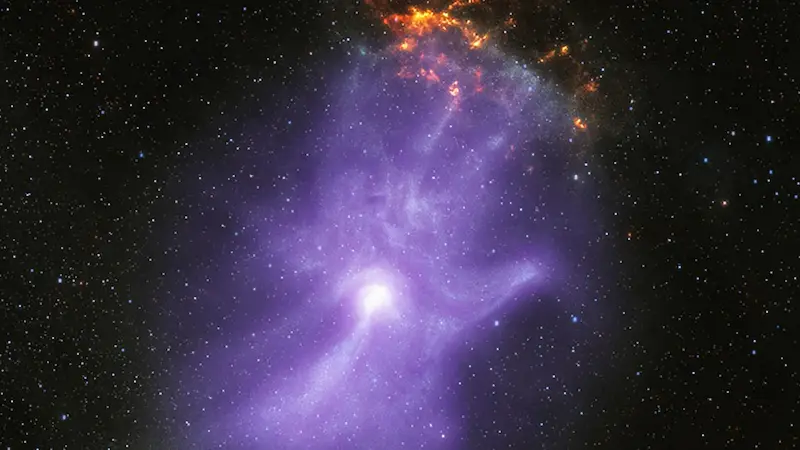


Unveiling some of the eerie wonders lurking in the depths of space, recent NASA missions have captured creepy celestial features that are sure to send shivers down your spine, just in time for Halloween. Among these unearthly sightings is a haunting "face" on Jupiter and a ghostly, skeletal hand-shaped nebula.
The Juno mission, which has been orbiting Jupiter and its moons since 2016, recently made its 54th close flyby of the gas giant. During this pass, the JunoCam instrument captured mesmerizing images of swirling clouds and storms in Jupiter's northern regions, particularly along the terminator - the line that separates the day side from the night side. In a fascinating phenomenon known as pareidolia, where recognizable patterns are seen in random shapes, the processed imagery revealed a Picasso-like face emerging from the turbulent atmosphere. Citizen scientist Vladimir Tarasov used the raw data made available on the JunoCam website to bring this spooky countenance to life. The hauntingly captivating image was further accentuated by the low angle of sunlight, as Juno soared approximately 4,800 miles above the planet's cloud tops.
Shifting our gaze farther into the cosmos, we encounter a celestial structure resembling a skeletal hand, bathed in an ethereal glow. The X-ray telescopes have unveiled the "bones" of this peculiar nebula, known as MSH 15-52, located a staggering 16,000 light-years from Earth. The nebula was fashioned around 1,500 years ago when a massive star underwent a cataclysmic collapse, leaving behind a dense remnant called a neutron star. This particular nebula stands as a testament to the powerful forces unleashed by rapidly spinning neutron stars with intense magnetic fields, known as pulsars. Through their energetic jets and powerful winds, the newborn pulsar created the captivating hand-shaped nebula.
In 2001, NASA's Chandra X-ray Observatory first observed the bright pulsar, named PSR B1509-58, nestled within the palm of the nebular hand. The pulsar's jet can be traced down to the "wrist" region, forming a striking visual connection. Recently, the newly-launched Imaging X-ray Polarimetry Explorer (IXPE) embarked on a 17-day observing campaign to delve even deeper into the mysteries of this nebular oddity. This extended observation period marked the longest for the space observatory since its launch in December 2021. The data collected by IXPE has provided scientists with the first-ever magnetic field map of the nebula's hand-like structure. By studying the charged particles that produce the X-rays as they travel along the magnetic field, researchers can decipher the fundamental shape of the nebula, akin to how bones shape a human hand.
Thanks to the unique capabilities of the IXPE telescope, scientists are now able to discern the regions within the magnetic field where particles are accelerated due to turbulence. This invaluable information allows for a deeper understanding of the underlying mechanisms shaping these cosmic phenomena. With each new discovery, the enigmatic nature of our universe becomes all the more apparent, sparking awe and curiosity in the minds of both scientists and space enthusiasts alike.
As we revel in the Halloween season, these eerie cosmic sightings serve as a reminder that the boundless expanse of space is filled with infinite mysteries, waiting to be unraveled by the curious minds of humanity.