


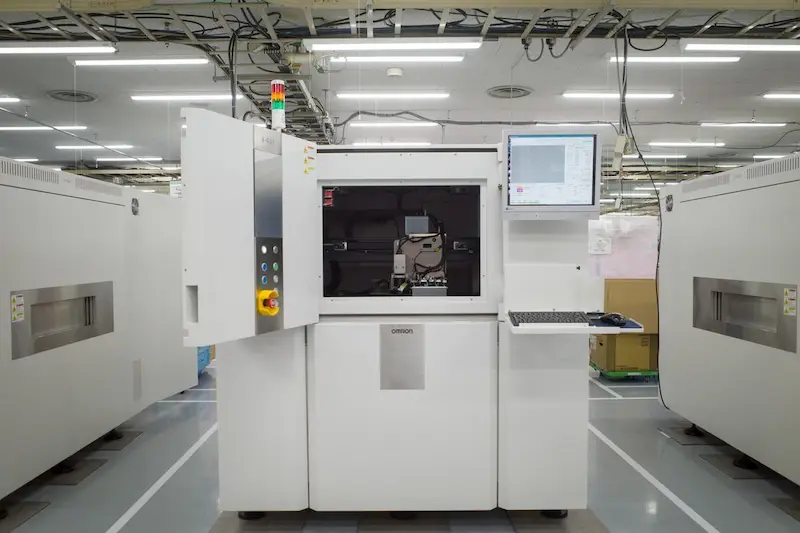


Japanese electronics firm Omron Corp. is expanding its focus to the chipmaking gear market in a bid for future growth. The company is set to launch an X-ray scanner called the VT-X950 in the spring, specifically designed to improve production yields for major chipmakers by detecting flaws in advanced semiconductor manufacturing. With the ability to produce 3D images of chips at a 1-nanometer scale, the machine is a generation ahead of current silicon fabrication techniques, providing chipmakers with real-time monitoring and more efficient adjustments and corrections during production.
The semiconductor industry is continuously evolving, with a trend towards manufacturing a wider variety of chips in smaller lots. Omron's general manager of inspection systems, Kazuhisa Shibuya, emphasized the importance of real-time CT scanning in meeting this demand. The ability to quickly identify and rectify defects is crucial for fabricators like Taiwan Semiconductor Manufacturing Co. and Samsung Electronics Co., as it directly impacts their costs and speed in fulfilling customer orders.
Omron, a 90-year-old company that earns over half of its annual revenue from factory automation products, first entered the semiconductor supply chain in 2012 with the release of its VT-X900. While this venture remains relatively small, primarily limited to a few major chipmakers, Shibuya is confident that the demand for their CT scanning machines will continue to grow. As the complexity and cost of chip manufacturing increases, the precision requirements for writing metal lines and depositing nanoscale solder bumps within a small area intensify. Advanced techniques like TSMC and Samsung's gate-all-around architectures further emphasize the need for CT scans as part of the semiconductor manufacturing process.
The urgency for CT scans stems from the increasing need for quality control and yield improvement. For instance, the production of high-end chips like Nvidia Corp.'s AI accelerators heavily relies on advanced packaging capabilities from manufacturers like TSMC. In such cases, any misalignment during the manufacturing process can render chips, worth tens of thousands of dollars, useless. By incorporating X-ray scanning into the production process, imperfections can be detected earlier, allowing workers to fine-tune the process and minimize wastage.
The significance of real-time CT scanning becomes even more apparent when considering the potential losses faced by companies due to manufacturing challenges. Recently, Sony Group Corp.'s share price dropped by 4.7% after the company encountered difficulties in mass-producing its newest smartphone camera sensor, leading to a 15% decline in the business' operating profit outlook. By implementing Omron's CT scanners directly on assembly lines, chipmakers have a practical option for high-quality, real-time imaging, which significantly reduces inspection time compared to traditional methods.
Omron's CT scanners are considered the most viable solution for chipmakers, as they offer the ability to produce high-quality CT images in real-time. Moreover, the latest model has reduced the scanning time by half compared to its predecessor. With the increasing costs associated with cutting-edge chip manufacturing, the importance of real-time monitoring and inspection to minimize wasted materials becomes crucial. Analysts predict a drastic increase in the need for faster inspection machines, making Omron's offering timely and valuable for the industry.