


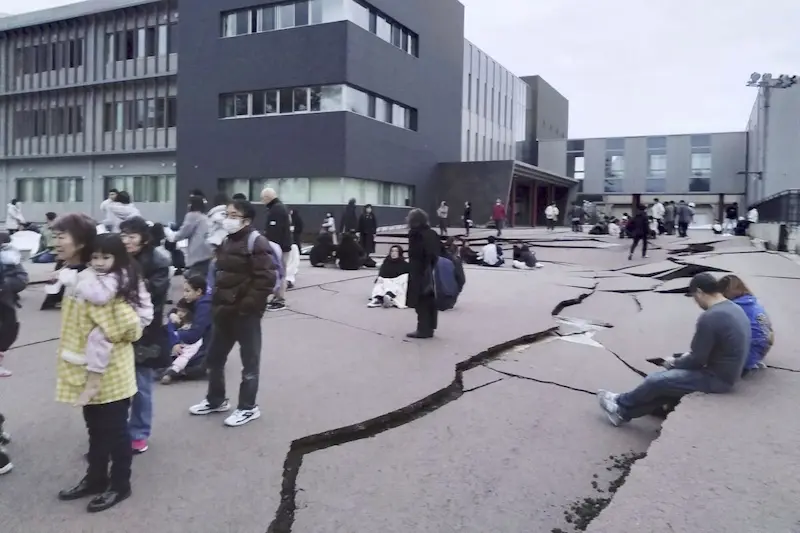


A powerful earthquake with a magnitude of 7.6 struck off the Noto Peninsula on Japan's northwest coast, causing widespread devastation and triggered a series of aftershocks. The tremors demolished homes, roads, and infrastructure, and led to a widespread tsunami warning in the region. Japan's Chief Cabinet Secretary, Yoshimasa Hayashi, reported that six cases of collapsed buildings with people trapped inside have been confirmed. In response, the government has deployed the Self-Defense Forces, and emergency services are overwhelmed with distress calls.
The city of Wajima faced a major fire outbreak, which rapidly spread across multiple buildings, as captured in video footage by broadcaster NTV. Furthermore, NHK reported that Wajima was struck by a tsunami, the largest recorded at 1.2 meters (4 feet). Consequently, Japan issued a tsunami warning for its entire western coast, urging residents to evacuate to higher ground and remain there until the alert is lifted. Even Hokkaido, located in the far north, was affected by the tsunami.
The earthquake caused suspension of train services, shutdown of power plants, closure of several roads, and the shutdown of an airport runway due to infrastructure damage. Nuclear reactors were also inspected for any potential damage. Mobile phone services were disrupted as well.
In Ishikawa prefecture, seven people sustained injuries across various towns, according to broadcaster TBS. On social media platforms, users shared images of collapsed houses in Wajima, which is around 300 kilometers (190 miles) northwest of Tokyo. Shops were left in disarray, filled with shattered glass bottles and fallen items.
Despite the initial tsunami, there are concerns that another tsunami measuring up to 3 meters in height may occur, as reported by NHK. The warning extended from Hokkaido to Kyushu, Japan's main northern and southwestern islands. South Korea also experienced small tsunamis in certain areas.
The Japan Meteorological Agency cautioned residents to remain vigilant about potential large aftershocks in the coming week. Power plants in the region were significantly impacted, with Hokuriku Electric Power Co.'s Nanao Ohta coal-fired units shutting down, causing a loss of approximately 1.2 gigawatts of capacity. Jera Co. also halted a gas-fired unit at its Joetsu power station for inspection.
As a result of the earthquake, around 32,600 households were left without power. This situation is particularly challenging due to the near-freezing temperatures in the area, with many families forced to huddle together during the holiday season.
Fortunately, no abnormalities were detected by Japan's Nuclear Regulation Authority at the nuclear power plants in the affected region, including Hokuriku Electric's Shika nuclear power plant and Tokyo Electric Power Co.'s Kashiwazaki Kariwa nuclear power plant.
Japan, known for its high earthquake frequency, suffered a devastating magnitude 9 earthquake in 2011. This event caused a massive tsunami that claimed around 20,000 lives and led to the destruction of the Fukushima Dai-Ichi nuclear plant. The recent earthquake serves as a reminder of Japan's vulnerability to seismic activity and its ongoing efforts to mitigate the impact of such disasters.