


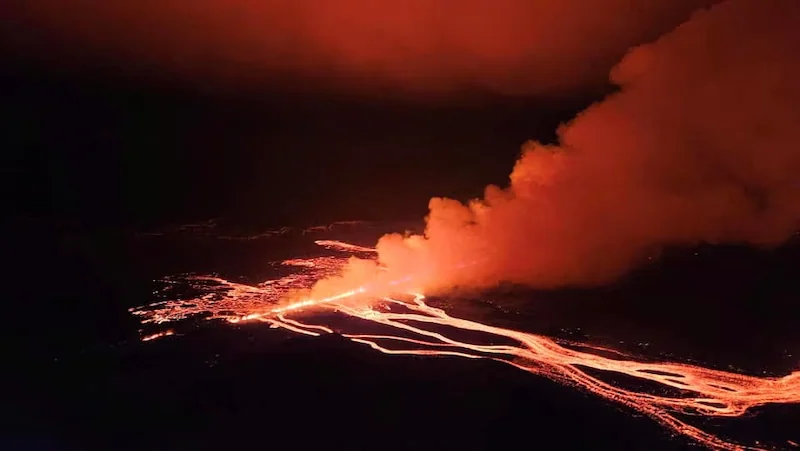


In southwest Iceland, the fiery displays from a volcano that illuminated the night sky on Saturday have now slowed down on Sunday. Remarkably, man-made barriers have proven effective in redirecting the lava flow away from important infrastructure, including a nearby fishing town. This eruption, the fourth in a series that began last December, started on Saturday evening. Spectators witnessed fountains of molten rock shooting into the air from a roughly 3 km-long fissure, mirroring the size and location of the previous eruption in February.
Halldor Geirsson, an associate professor at the University of Iceland's Institute of Earth Sciences, described the eruption as notably vigorous, with a substantial amount of material being ejected compared to the previous event. This led to a swift flow of lava. Authorities had been on high alert for weeks, anticipating an eruption on the Reykjanes peninsula, just south of the capital city, Reykjavik, as magma had been building up underground.
Livestream footage on Sunday morning captured the lava inching perilously close to Grindavik, a fishing town with around 4,000 residents that had been evacuated during previous eruptions in November and February. Some individuals who had returned home after the last evacuation were once again forced to leave on Saturday. Geirsson reassured the public, stating that the lava flow rate was gradually decreasing, with most of the lava heading eastwards, away from the town and towards the sea, thanks to the successfully implemented barriers.
The Icelandic Meteorological Office was closely monitoring the situation, particularly the lava's trajectory towards the Svartsengi geothermal power plant in the area. Fortunately, volcanic activities in the Reykjanes peninsula, characterized by fissure eruptions, typically do not result in significant explosions or the dispersal of ash into the stratosphere. By midday on Sunday, the fissure's activity had subdued, with lava now flowing from three separate locations.
Despite the volcanic activity, Keflavik Airport and other regional airports in Iceland remained fully operational, unaffected by the eruptions. The famous Blue Lagoon geothermal spa, a popular tourist destination, shut its doors as a precautionary measure, as it had done during previous eruption events. The eruption in February had disrupted heating for over 20,000 individuals due to destroyed roads and pipelines from the lava flows. The ongoing eruption, while a spectacle to behold, continues to be closely monitored to safeguard lives and critical infrastructure in the area.