


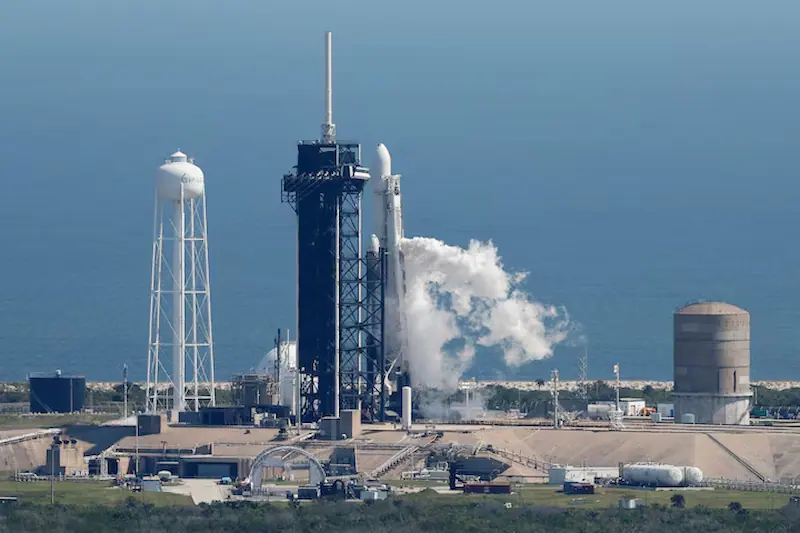


In a monumental launch from Florida, NASA propelled the Europa Clipper spacecraft towards Jupiter on a vital mission to unravel the mysteries of Europa, one of Jupiter's moons. Departing from the Kennedy Space Center aboard a SpaceX Falcon Heavy rocket, the solar-powered probe is set to delve into the potential habitability of Europa, with a keen focus on its hidden subsurface ocean enclosed by a thick icy shell.
This groundbreaking spacecraft, the largest ever designed by NASA for a planetary mission, embarks on a 5-1/2-year journey spanning roughly 1.8 billion miles. By 2030, it is slated to establish orbit around Jupiter, marking a significant step in humanity’s quest to understand the possibilities of life beyond Earth.
Despite being just a fraction of Earth’s size, Europa's colossal global ocean, believed to harbor twice as much water as our own oceans, presents an intriguing prospect for extraterrestrial life. With its icy shell concealing a potentially hospitable environment below, Europa has long captivated scientists as a potential cradle for life in our solar system.
The Europa Clipper's mission objectives are ambitious, aiming to unravel the mysteries of Europa's internal ocean, map its surface composition, and search for water vapor plumes venting from beneath the icy crust. This comprehensive exploration strategy involves 49 close flybys over three years, bringing the spacecraft as close as 16 miles to Europa’s surface for a detailed examination.
Operating in the daunting radiation environment surrounding Jupiter, the Europa Clipper serves as a testament to NASA's engineering prowess. Equipped with a protective vault to shield its electronics from Jupiter's relentless radiation, the spacecraft must navigate this harsh terrain while collecting crucial data to investigate Europa’s potential for hosting life.
With over 6,060 pounds of propellant and an array of scientific instruments, the Europa Clipper is primed for its intricate mission. A complex trajectory involving flybys of Mars and Earth will propel the spacecraft towards Jupiter, utilizing gravity assists to enhance its momentum. As it unfurls its solar arrays to harness sunlight for power, the Europa Clipper stands at the forefront of humanity’s pursuit to redefine our understanding of life in the cosmos.