


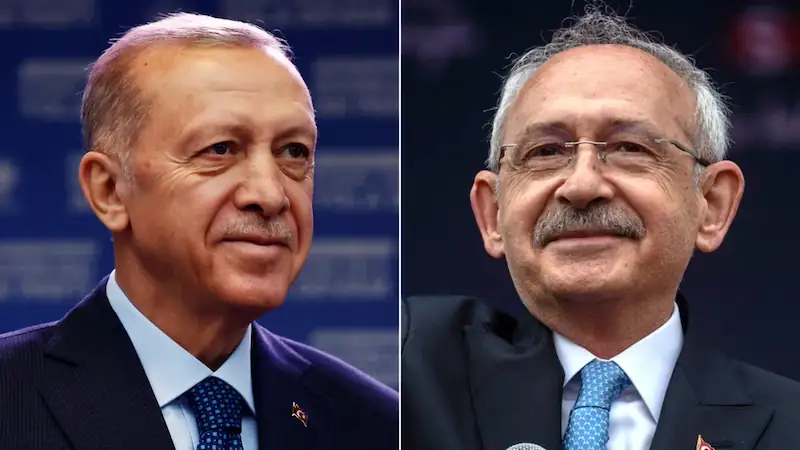


On Sunday, June 26th, Turkey's presidential run-off election will take place, featuring the country's long-term leader, Recep Tayyip Erdogan, up against opposition candidate Kemal Kilicdaroglu. The first round of the election was marked by a narrow race, surprising analysts who expected Erdogan to win outright after twenty years in power. Instead, he only narrowly missed the mark, facing Kilicdaroglu in the run-off.
Turkey's elections occur every five years, with candidates nominated by parties that have passed the 5% voter threshold in the previous parliamentary election or those who have garnered at least 100,000 signatures supporting their nomination. The presidential candidate who receives over 50% of the vote in the first round is elected president, while a run-off between the two top candidates is required if no candidate achieves a majority vote.
The run-off candidates in Turkey's presidential race are Erdogan and Kilicdaroglu. Erdogan has been in power for two decades, first as the country's prime minister and then as president. During his reign, Erdogan has gradually consolidated power, and Turkey's economy has suffered because of unorthodox fiscal policies, going from an economic boom to a disastrous slump that has resulted in high inflation and reduced purchasing power among the public.
Sinan Ogan, another right-wing candidate, garnered 5.17% of the votes in the first round and has announced his endorsement of Erdogan in the run-off.
Kilicdaroglu is a member of the Republican People's Party (CHP), Turkey's oldest political party formed 100 years ago by Mustafa Kemal Ataturk, the founding father of modern Turkey and a staunch secularist. Erdogan's Islamist-rooted party and its conservative base stand in contrast to Kilicdaroglu's secular leanings, although the opposition candidate and his coalition have vowed to represent all factions of Turkish society.
Turkey sits at the heart of an increasingly polarized global political climate, and with a population of 85 million residents and one of the world's largest economies, its political future carries significant implications worldwide. A NATO member, Turkey has strengthened ties with Russia under Erdogan's leadership. The likelihood of a foreign policy U-turn in Turkey is uncertain, regardless of who wins the run-off.
In addition to the state of the economy, Turkish voters are concerned with earthquake disaster management and Erdogan's turn away from democracy. Despite facing his most considerable opposition in years, Erdogan is still expected to do reasonably well in the run-off. His base of religious supporters remains strong, and there is little evidence that the economic downturn or his early response to the February earthquake has significantly affected his support.
However, if Erdogan wins the run-off by a wide margin, critics fear this may lead to a further erosion of democratic values and an end to social autonomy in Turkey. Nevertheless, the majority of Istanbul's votes went to the opposition in the May 14th election, indicating that Turkey's political future remains uncertain.