


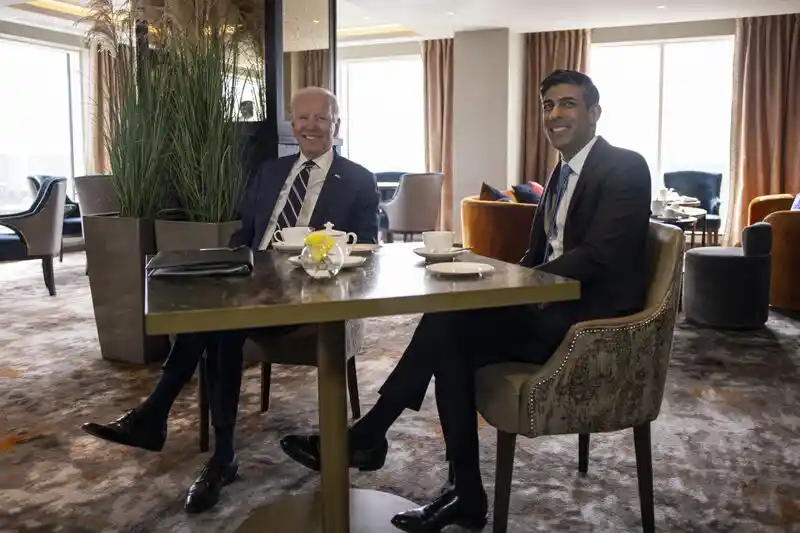


Rishi Sunak, the United Kingdom’s Chancellor of the Exchequer, is set to have his most extensive interactions with the United States since taking office in October. During his two-day visit to Washington, he will meet with President Joe Biden, where they will confer on a range of issues regarding economic and cultural links between the UK and the US.
One of the subjects that they will discuss is trade. A US-UK trade deal is seen as a priority by successive Conservative administrations, and envoys had already held five rounds of negotiations under former President Donald Trump. However, Biden has halted trade talks, leaving the UK government to pursue state-level memoranda of understanding instead. Despite this setback, sources suggest that Britain still seeks a trade deal in “all but name”.
The topic of subsidies could also come up during their discussions. The Inflation Reduction Act, a $369 billion package of tax cuts and subsidies for green industries, has raised concerns across the Atlantic that investment could be drawn away from the UK towards the US. The UK government is currently considering its own subsidies, as it risks being stuck between two economic giants. UK Energy Secretary Grant Shapps has said that the Biden administration has given assurances that the policy will not hurt US allies.
The ongoing situation in Ukraine is another subject that the two leaders are bound to discuss. There have been signs that Ukraine has increased military activity against Russia, and the US and UK have been consistent in their support for Ukraine. The UK has provided main battle tanks and Storm Shadow cruise missiles to Ukraine, and other NATO members have followed suit. Also, Sunak may seek support for Defense Secretary Ben Wallace becoming the next NATO leader.
Sunak and Biden will also have the opportunity to discuss China. The UK has deep historical ties with the Asian nation and is keen to play a leading role in the US’s Indo-Pacific strategy. However, Sunak has so far been cautious about worsening already strained relations with China over Beijing’s crackdown on democracy in Hong Kong. The two leaders could elaborate on their plans to protect critical infrastructure and supply chains from Chinese influence.
Finally, the two leaders could discuss concerns about rapid advances in artificial intelligence and its potential to spread misinformation, disrupt labor markets, and cause unforeseen societal disruptions. The UK has more than 3,000 AI companies generating £10 billion ($12.4 billion) in annual revenue and is advancing plans to establish a global watchdog for the technology in London. However, it was left outside looking in last month as American and European officials gathered in Sweden to discuss a “code of conduct” to prevent AI companies from doing harm. Sunak could seek to establish a bridge between differing regulatory approaches taking shape in Brussels and Washington.
Sunak’s visit to Washington will be a significant moment for both him and the UK government as they seek to reaffirm the special relationship that exists between the two countries. The Brexit aftermath and a renewed US focus on Asia have made this journey even more critical. Whether or not this meeting leads to any concrete outcomes, the gesture itself is symbolic and emphasizes the importance of dialogue and effective communication between allied nations.