


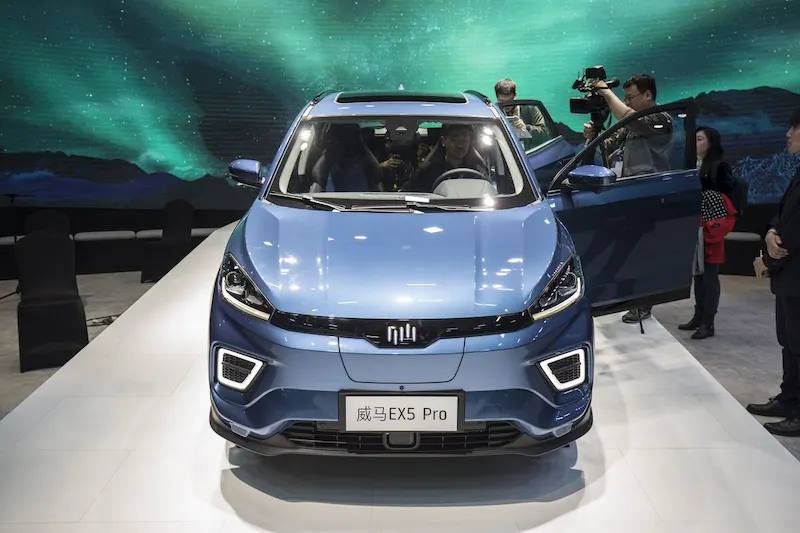


Chinese electric vehicle manufacturer WM Motor is facing severe financial difficulties and plummeting sales, prompting the company to take drastic measures to salvage its business. The company recently announced that a Shanghai court has accepted its pre-restructuring application, signaling its intention to restructure its operations and address its financial and debt problems. WM Motor, which was once seen as one of the most promising EV startups in China, has been hampered by a multitude of challenges, including the sluggish capital market, volatile raw material prices, and funding setbacks.
Just a month ago, WM Motor's prospects looked brighter when Apollo Future Mobility Group Ltd. planned to acquire the company for $2.02 billion. However, citing uncertainties in the financial market and China's uneven economic recovery, Apollo backed out of the deal. This setback has further compounded the issues faced by WM Motor, leaving the company in a precarious situation.
The struggles of WM Motor epitomize the highly competitive and volatile nature of the Chinese electric vehicle market. With BYD Co. dominating approximately one-third of all new energy vehicle sales in China, smaller players like WM Motor have struggled to gain a significant foothold. While WM Motor managed to sell around 35,000 electric sport utility vehicles in both 2020 and 2021, its sales plummeted to a mere 1,387 cars in the first eight months of 2022.
Initially backed by major players such as Baidu Inc. and Tencent Holdings Ltd., WM Motor had high hopes of becoming a market leader in the Chinese EV industry. The company even considered a listing on China's equivalent of Nasdaq and set delivery records. However, its aspirations have since been dashed, leading to layoffs, factory shutdowns, and reduced aftersales services.
The Chinese EV market has experienced significant changes in recent years. With around 100 manufacturers producing pure-electric and plug-in hybrid models, the industry has undergone a consolidation, down from approximately 500 registered makers in 2019. Government subsidies played a significant role in propelling the industry forward. In August, the China Passenger Car Association reported a record-breaking delivery of 716,000 Chinese-made EVs and plug-in hybrids, primarily driven by major players like BYD and Tesla Inc.
However, the Chinese market also witnessed a fierce price war initiated by Tesla about a year ago, which has strained the margins of manufacturers, including WM Motor. In light of these challenges, other Chinese EV startups, such as Nio Inc. and Xpeng Inc., have sought additional funding to sustain their operations. Nio recently sold a 7% stake to an entity controlled by Abu Dhabi for $740 million and is considering raising another $3 billion, while Xpeng secured a $700 million investment from Volkswagen AG.
As WM Motor embarks on the restructuring process, the company hopes to find a path towards recovery and sustainability. The outcome of this restructuring is uncertain, but WM Motor remains committed to exploring new strategies, engaging with relevant parties, and avoiding bankruptcy. The Chinese EV market continues to evolve rapidly, and while WM Motor's future remains uncertain, the industry as a whole continues to show promising growth and innovation.