


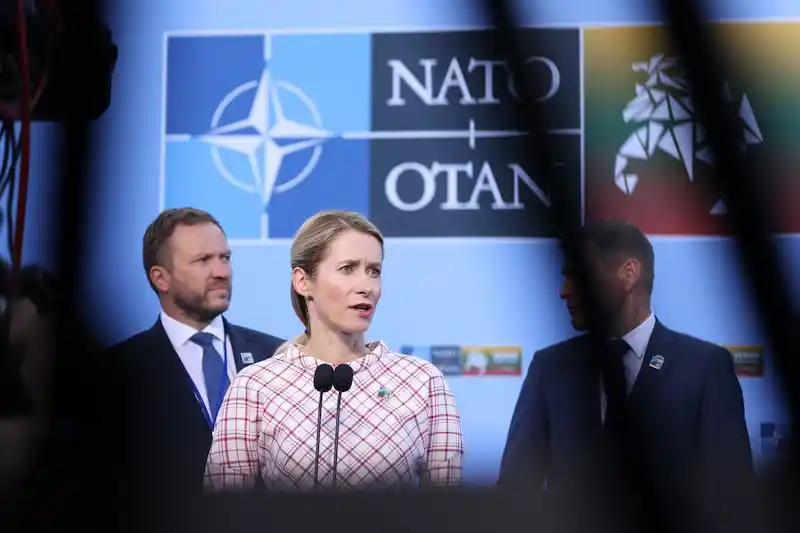


Estonian Prime Minister, Kaja Kallas, has expressed her interest in becoming NATO's next Secretary General, confirming long-held suspicions about her ambition for the position. Speaking at a defense-related event in Washington organized by Politico, Kallas left no room for ambiguity when asked about her interest in succeeding Secretary General Jens Stoltenberg, whose term runs until October next year.
Kallas emphasized that NATO members are seeking a female candidate from a newer member state that meets the alliance's defense spending target of 2% of GDP. Highlighting her firm stance against Russian President Vladimir Putin and her support for Ukraine's war effort, Kallas made it clear that she fits the criteria for the role. However, her geopolitical aspirations clash with domestic challenges in Estonia.
The Estonian Prime Minister currently faces calls to resign over a scandal involving her husband's business activity in Russia. In August, it was revealed that her husband's logistics company had continued making deliveries to a Russian client, despite Kallas publicly urging a halt in trade with Russia. Though Kallas maintains that she was unaware of these activities and her husband has since sold his shares in the company, the scandal has prompted accusations of hypocrisy from across the political spectrum.
While Estonia's president has suggested that Kallas should step down, the Prime Minister has vowed to remain in her position. Nevertheless, the scandal has impacted her popularity and the standing of her Reform party in the polls.
During her visit to the United States capital, Kallas met with officials, including National Security Adviser Jake Sullivan, to advocate for continued assistance for Ukraine. As support for Ukraine shows signs of waning, Kallas emphasized her belief that Ukraine has the potential to overcome the challenge posed by Russia, stating, "I totally understand and believe that it is beatable. Ukraine can win this war."
Kallas's gender could work in her favor in her bid for NATO Secretary General, as many member states have expressed a preference for a female candidate. Since 1952, the alliance has been led exclusively by men, with the upcoming vacancy offering an opportunity for a historic shift. However, Kallas will face competition for the position. Outgoing Dutch Prime Minister Mark Rutte has recently signaled his openness to the job.
Notably, some NATO allies have previously viewed Baltic candidates as too hawkish on Russia, which could potentially affect unanimous support. However, the dynamic may have changed following Russia's invasion, which has prompted a significant overhaul of the alliance's defenses - the most significant since the end of the Cold War. As the race for the next NATO Secretary General begins to take shape, it remains to be seen how Kallas's domestic challenges and geopolitical ambitions will impact her chances.