


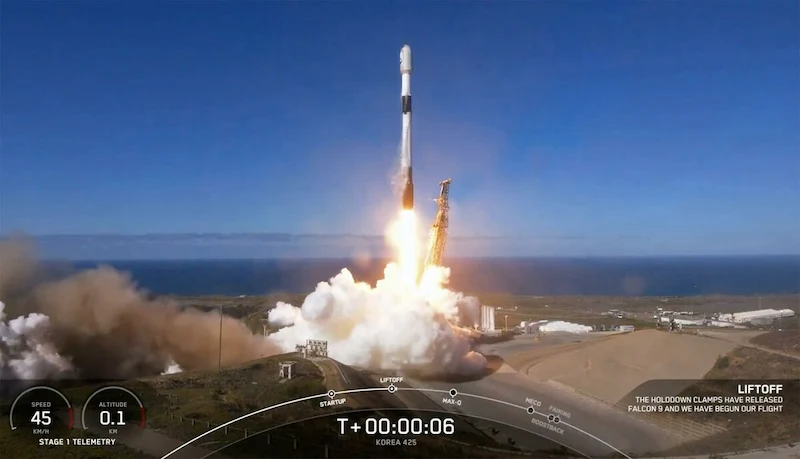


In a significant development in the escalating rivalry between North and South Korea, Elon Musk's SpaceX successfully launched South Korea's first domestically made spy satellite into orbit. The launch took place from the Vandenberg Space Force Base in California on Friday morning, as confirmed through a SpaceX webcast. Although the satellite deployment could not be immediately confirmed as the webcast ended after the reusable booster returned to Earth, it marks a crucial step for South Korea in enhancing its reconnaissance capabilities.
North Korea had previously launched its own spy satellite last month, enabling the regime to closely monitor US troop movements in the region. South Korea, which has traditionally relied on US space-based intelligence, aims to supplement its access by expanding its own reconnaissance capabilities. Their goal is to put five spy satellites into orbit by 2025, reducing their dependency on the US for satellite images.
Sejin Kwon, an aerospace engineering professor at the Korea Advanced Institute of Science and Technology, emphasized that the US does not provide South Korea with all the satellite images they require. Consequently, South Korea is increasingly determined to strengthen its own space program as part of its broader efforts. Back in May, they launched a Nuri rocket that successfully transported eight satellites into orbit, showcasing their commitment to space exploration.
South Korea and North Korea now join a growing list of countries seeking to expand their data collection through space-based satellites. Japan, for example, has plans to increase its network of information-gathering satellites from five to nine in the coming years to better monitor neighboring countries with nuclear capabilities. In July, an Indian rocket launched an Israeli-made Earth observation satellite, catering to Singaporean users, further highlighting the global trend of bolstering space-based intelligence.
While North Korea's spy satellite improves its ability to target potential nuclear strikes in South Korea and Japan, South Korea's newly launched satellite is expected to have significantly better capabilities. Experts believe that the North Korean satellite has a relatively basic optical system and offers lower-resolution images compared to commercial satellites. In contrast, the South Korean satellite is equipped with a state-of-the-art telescope containing electro-optical and infrared sensors. It has a resolution capacity that is approximately 100 times better than its northern counterpart and can identify objects as small as 30 centimeters (12 inches).
The successful deployment of South Korea's spy satellite enhances their ability to gather intelligence independently. This is particularly important as it acts as a safeguard against any potential political changes in the US that may impact information sharing. Former President Donald Trump had previously threatened to withdraw US troops stationed in South Korea during his tenure. South Korea perceives the deployment of these spy satellites as part of a security triad with the US and Japan. The triad focuses on launching preemptive strikes, intercepting missiles in flight, and engaging in offensive actions to neutralize North Korea's military and command assets.
Overall, the successful launch of South Korea's first spy satellite underscores their determination to assert themselves in space-based intelligence gathering. As the rivalry between North and South Korea expands into outer space, both countries are positioning themselves to enhance their national security and protect their interests in the region.