




Glaciers in the Himalayas are famously known for their rapid melting due to the effects of the global climate crisis. However, a recent study published in the journal Nature Geoscience has revealed a surprising phenomenon in the world's tallest mountain range that could actually be helping to slow down the impacts of climate change.
The study explains that when the surrounding air above Himalayan glaciers warms, it creates a temperature gap between the cooler air in direct contact with the ice. This leads to an increase in turbulent heat exchange at the surface of the glaciers and results in a stronger cooling effect of the air mass above. As the cool air becomes denser, it sinks and flows down the slopes into the valleys, causing a cooling effect in the lower areas of the glaciers and the surrounding ecosystems.
Considering that the Himalayan glaciers feed into 12 rivers, which in turn provide fresh water to nearly 2 billion people across 16 countries, it is crucial to investigate whether this self-preserving cooling effect can continue as temperatures rise in the coming decades.
Previous reports have shown that the glaciers in the region melted 65% faster in the 2010s compared to the previous decade, indicating the significant impact of rising temperatures on the ice masses. The melting is primarily caused by the lengthening and intensification of the melt season, leading to thinning and retreat of the glaciers. This process further increases the air temperature due to larger energy absorption by the exposed surfaces.
Interestingly, while overall temperatures seemed stable at the base of Mount Everest, a closer analysis revealed a different picture. While minimum temperatures were steadily increasing, the maximum surface temperatures during summer were consistently dropping. This paradoxical observation prompted further investigation.
However, despite the presence of these cooling winds, they are not enough to fully counteract the increasing temperatures and glacier melt caused by climate change. The study acknowledges that the reason for the rapid melting of these glaciers is complex and cannot be solely attributed to the local cooling effect.
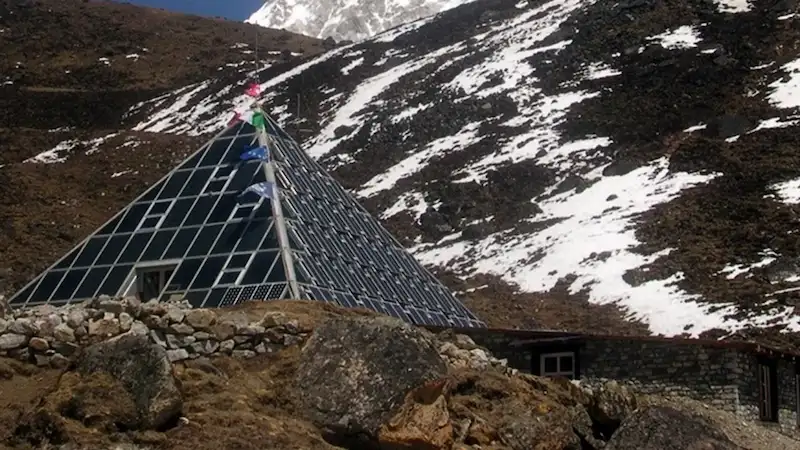
The scarcity of data in high-elevation areas around the world prompted the study team to focus on ground observations from a climate station in the Himalayas. This station recorded meteorological data for nearly three decades, offering a rich source of information. These detailed observations led the researchers to conclude that warming temperatures trigger katabatic winds, which are cold winds flowing downhill, commonly found in mountainous regions.
It was also noted that the katabatic winds result in higher ground-level ozone concentrations and act as a pump, transporting cold air from higher elevations down to the valleys. Overall, this process contributes to preserving the permafrost and surrounding vegetation in the region.
While the study hints at the potential of this phenomenon to mitigate the impacts of climate change, the researchers emphasize the importance of further analysis and the need for more long-term ground stations to verify and understand the broader implications of their findings.
In conclusion, this study sheds light on a surprising yet beneficial phenomenon occurring in the Himalayas. The presence of katabatic winds, triggered by warming temperatures, contributes to cooling effect and preservation of the glaciers. However, the overall melt rate of these glaciers is still alarming, and more multidisciplinary research is needed to fully comprehend the effects of global warming in these vulnerable regions and take appropriate measures.