


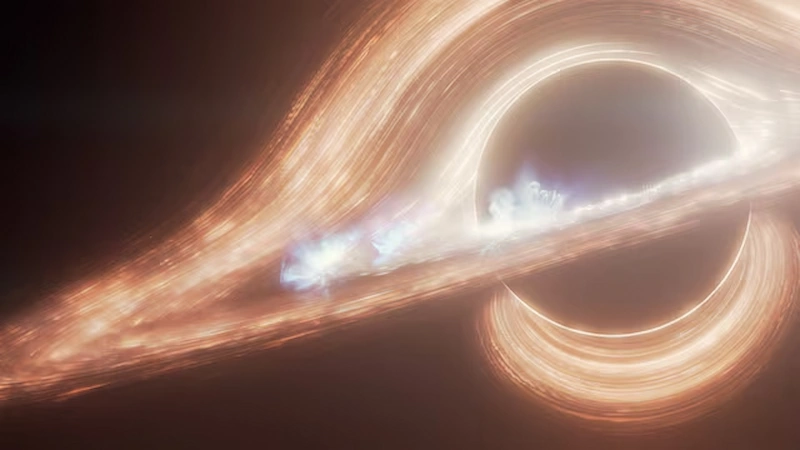


In a groundbreaking new study, researchers utilizing NASA's James Webb Space Telescope have gained unprecedented insights into the turbulent events unfolding near the supermassive black hole at the heart of our Milky Way galaxy. The telescope's observations reveal a dynamic and ever-changing environment around the black hole known as Sagittarius A* (Sgr A*), characterized by a continuous flickering of light interspersed with occasional intense flares as matter is drawn inexorably towards its gravitational grasp.
The data collected by Webb, which commenced its observations in 2022, has allowed astronomers to observe the region surrounding Sgr A* for extended periods, a capability never before achieved. Unlike the previously perceived static state, the researchers discovered a bubbling cauldron of activity around the black hole, where the accretion disk—a disk of swirling gas—exhibits a constant flickering originating from the vicinity of the event horizon, the boundary marking the point of no return.
Astrophysicist Farhad Yusef-Zadeh, the lead author of the study, describes the chaotic nature of the accretion disk, attributing the flickering to the turbulence and compression experienced by gas as it nears the black hole under immense gravitational forces. This compressed gas occasionally gives rise to flares akin to solar flares, caused by the intense magnetic fields within the disk colliding and merging blobs of gas.
Although reminiscent of solar flares, these energetic bursts occur in a vastly different astrophysical context and at significantly higher energy levels. While observing black holes directly poses a challenge due to their light-swallowing nature, Webb's observations focus on the surrounding material, shedding light on the mechanisms at play near these enigmatic cosmic entities.
Sagittarius A* harbors a mass approximately 4 million times that of our sun and lies 26,000 light-years away from Earth. The recent observations, conducted over a total of 48 hours in several increments, are unveiling new understandings of how black holes interact with their environments, with the researchers estimating that about 90% of the accretion disk's material plunges into the black hole.
Contrary to previous assumptions, the researchers propose that the accretion disk's material is primarily sourced from the stellar winds of neighboring stars, capturing ejected gas from these stars rather than material torn from a star straying too close. The study's findings mark a significant advancement in our comprehension of the intricate dynamics at play around supermassive black holes, offering a glimpse into the captivating yet elusive phenomena unfolding in the deep recesses of our galaxy.