


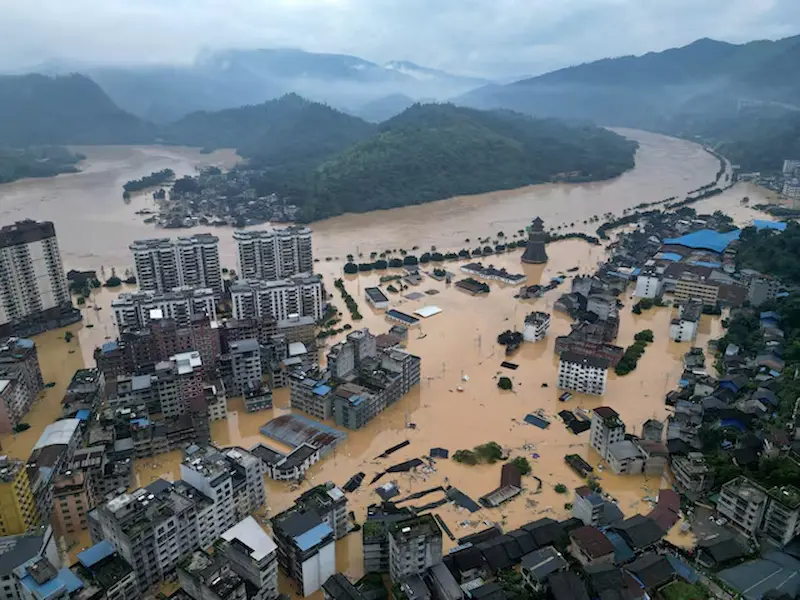


When the skies open up over China during summer, it’s not just umbrellas and soaked streets that follow. In recent years, a quieter kind of disruption has been swelling beneath the surface — one that touches fields, barns, family homes, and whole livelihoods. And this year, China has decided to reshape how it responds to those bearing the brunt of its flood management strategies.
Flood diversion, while technical in name, is deeply personal in impact. It means certain areas — often rural, often home to working families and farmers — are purposefully flooded to spare densely populated urban centers from destruction. This strategy isn’t new. China has nearly a hundred designated flood storage zones spread across its major river systems, including the mighty Yangtze, whose basin supports around one in three Chinese citizens. But as climate change leads to more intense and unpredictable rain events, the reliance on these zones has surged — and so have tensions.
In a shift that acknowledges the rising social cost, Beijing announced an updated compensation framework aimed at supporting those directly affected by these flood controls. For the first time, the central government will shoulder the majority of the financial burden — 70% of all compensation payouts, to be exact — while local governments cover the rest. In the past, the division of responsibility was left up to individual regions based on available funds and local economic conditions, which often meant delayed or insufficient support for victims.
The new rules go further than just changing who pays. They also redefine what can be compensated. In past years, only the loss of working animals — those used for plowing or transport — was eligible. Now, all livestock and poultry that can’t be evacuated in time are included, acknowledging the true scale of losses endured by rural households during a flood.
These changes come in the wake of memories that are still raw. Just last summer, the province of Hebei — which lies on the edge of Beijing — saw nearly a million people evacuated as torrential rains pushed authorities to open up eight flood diversion zones. Families lost homes and farmland. Many had lived peacefully for generations in areas that were designated as flood reserves but hadn't seen water in decades. When the rivers rose, so did resentment, especially as the capital city was spared by sacrificing its rural neighbors.
It wasn’t a one-off. This June, rainfall in the middle and lower stretches of the Yangtze reached levels double the norm, according to meteorological authorities. Elsewhere, weather stations in provinces like Hubei and Guizhou reported their wettest June days ever recorded. In Guizhou, a flood struck so forcefully that meteorologists estimated it was the kind of event seen once every half-century — a terrifying rarity, arriving faster than people could react.
In response, Beijing is not only promising compensation but also vowing to shift communities and industries out of the most vulnerable zones. More land will be set aside for future floodwaters, suggesting a larger, long-term rethinking of how the nation coexists with its rivers.
Still, the real test will be how this new framework plays out in the next emergency. Will funds reach people quickly enough? Will the losses be truly offset by the payments? And perhaps most importantly, will those whose homes lie in the path of water feel that their sacrifice was recognized — not just strategically, but humanely?
What’s unfolding isn’t simply a story of climate resilience or infrastructure. It’s one of fairness, of voice, of trying to keep trust afloat as the waters rise.