


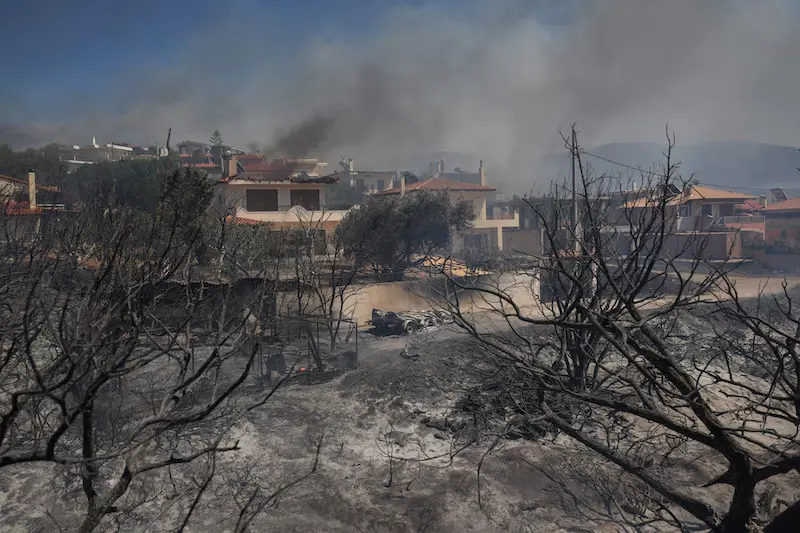


Saturday didn’t rise quietly over Greece. The air was already heavy before the sun got high, and by midmorning, the land felt like it was holding its breath under the weight of the third brutal heatwave this summer. North of Athens, near Drosopigi, it wasn’t just the temperature making the ground feel unstable. It was the smoke, the heat, and the distant, unnerving pop of explosions—most likely from flammable materials going up as fire reached the industrial edges of the village.
Just 25 kilometers outside the capital, the scene felt closer to a warzone than a countryside. Helicopters circled, dipping low to dump water, while plumes of thick, dark smoke crawled across the sky. On the ground, over sixty firefighters were locked in a battle against an unrelenting wall of flames. Backed by two aircraft and a couple dozen fire trucks, they pushed back wherever they could, but it was a struggle. Two homes were lost. More were under threat. Krioneri, the neighboring village, received urgent orders to evacuate—head toward Athens, the message read, and don't look back.
But the danger wasn’t just isolated to the mainland. Over on Evia—an island that's no stranger to fire—the wind was working against everyone. Gusts twisted and spread the flames, making aerial drops unpredictable and ground operations even riskier. Over 100 firefighters were deployed there, trying to contain the burn near Triada. Authorities didn't mince words. Be ready to leave at a moment’s notice, they warned residents. For many, bags were already packed.
Further south, Kythera was also feeling the heat—quite literally. Entire villages, like Aroniadika and Pitsinades, were evacuated. People left behind not just their homes but memories layered across generations. West of Athens, in Messinia, the same story played out. Fires forced residents of Kryoneri and Sellas out of their homes as flames licked closer.
By the afternoon, temperatures were pushing 44°C—no relief, not even in the shade. The Greek weather service didn’t have good news: more heat, more wind, more risk.
What’s hard to ignore is the scale of it all. These fires aren’t isolated incidents anymore. They’re becoming patterns—annual, predictable in the worst way. Greece, like much of the Mediterranean, is locked in this vicious cycle. The dry months arrive, winds whip through the mountains and valleys, and anything even slightly flammable becomes a spark away from a disaster.
Tourism, Greece’s economic heartbeat, is stumbling right in the middle of its busiest time. Beaches are quieter, resorts are wary, and cancellations are creeping in. No one books a vacation hoping to see smoke on the horizon or hear evacuation sirens in the night.
And yet, the country keeps pushing forward. Firefighters, volunteers, even locals with garden hoses—everyone is fighting, hoping to save one more house, one more grove of olives, one more stretch of coastline. But behind all that effort, there’s a quiet, rising fear: this may not be a bad summer—it may be the new normal.
The science isn’t vague anymore. These fires aren’t just nature having a moment. They’re part of something deeper, something global. The climate is shifting, and southern Europe is at the frontline. Greek officials, residents, and researchers have all started echoing the same thing—it’s time to rethink the old ways of preparing for fire. Because the fires have changed. Now, it’s our turn to catch up.