


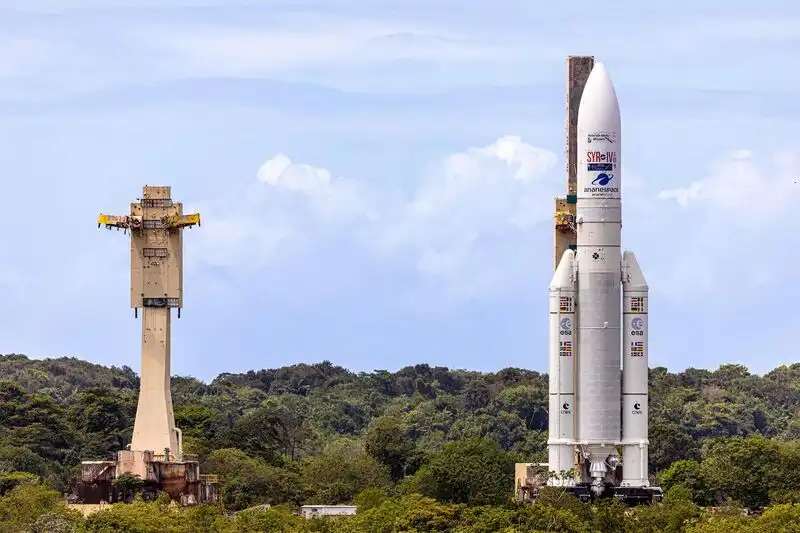


Europe bid farewell to its reliable workhorse rocket as the last Ariane 5 launched successfully on Wednesday. Operated by Arianespace SA, the European commercial launch provider, the rocket carried two satellites for the German Space Agency and the French Directorate of Armaments into space. This marks the end of a remarkable era for the Ariane 5, which played a key role in sending crucial payloads, including the James Webb Space Telescope, into orbit.
However, attention now turns to its successor, the Ariane 6. Arianespace plans to launch the Ariane 6 before the end of this year. The Ariane 6 is being developed by ArianeGroup, a joint venture of Airbus SE and Safran SA. The European Space Agency, responsible for the Ariane program, agreed in 2014 to develop a new and improved model, with an initial target launch date of 2020. However, the launch has faced several delays.
Although Arianespace is aiming for a 2023 launch, a major part supplier predicted a delay, suggesting that the Ariane 6 might not fly until early 2024. Over the past 25 years, the Ariane 5 has been instrumental in successfully launching heavy payloads to high orbits around the Earth. Its impressive track record includes launching critical communications satellites, such as the recent launch of the Webb telescope for NASA in 2021.
Originally scheduled for June 16, Arianespace had to postpone this final Ariane 5 mission due to technical issues with the rocket's pyrotechnical transmission lines. Despite this delay, the rocket ultimately completed its mission, marking the end of an incredible chapter in European space exploration.
As the Ariane 5 takes its final bow, anticipation builds for the Ariane 6 and its potential to continue expanding Europe's capabilities in space. The new rocket promises advancements in launch flexibility and cost-efficiency, ensuring that Europe remains a key player in the competitive space industry. The Ariane 5's impressive legacy will be remembered as a stepping stone towards greater achievements in space exploration, paving the way for future missions and discoveries.