


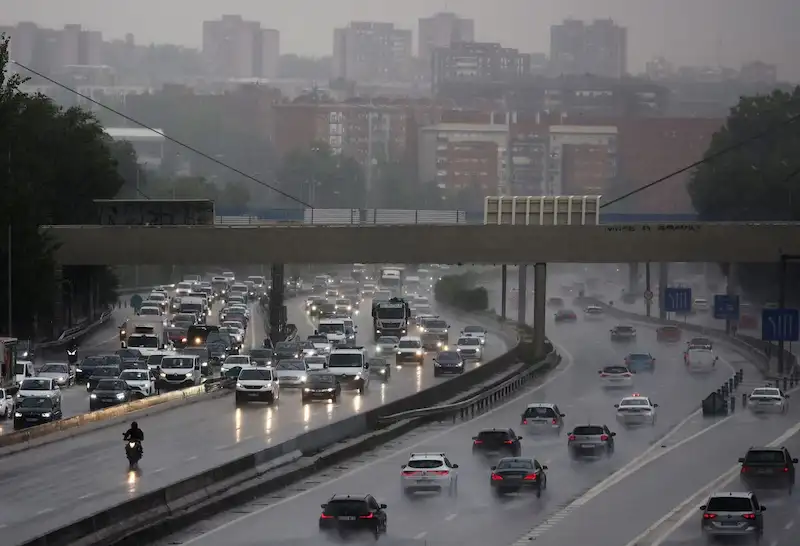


Torrential rains that began over the weekend and continued into Monday have wreaked havoc in Spain, causing at least four deaths and leaving hundreds stranded at train stations and roadsides. The heavy rainfall, which broke records in several cities including Valladolid, Segovia, and Toledo, prompted authorities to issue appeals for citizens to stay at home.
Spain's weather agency, Aemet, reported a record amount of rain in a 24-hour period. While the maximum alerts for rain have now been lifted, there are still expectations of continued rainfall, although at slightly reduced levels, throughout the week. Madrid Mayor José Luis Martínez-Almeida called on the city's residents to stay home, emphasizing the exceptional and anomalous nature of the situation and the need to reinforce emergency and security services.
Tragically, the extreme weather conditions have led to at least four deaths, while three people are reported missing. Such intense rainstorms, locally known as "cold drops," occur when cold air from the Arctic clashes with warm, humid air over the Mediterranean Sea. These events have become increasingly frequent and intense due to the effects of climate change, which has raised sea and atmospheric temperatures in the region.
To alert its residents, Spanish authorities issued a mass alert through mobile phones in the Madrid region, an unprecedented measure. The alert warned people of the severe risk of flooding over the following hours. On Sunday, the highest levels of rain in a single day since 1981 were recorded, with 92 liters per square meter falling in the capital.
In response to the hazardous conditions, public parks, cultural and sports facilities were closed, and a football match between Atlético de Madrid and Sevilla FC was canceled. Train services between Madrid and Andalusia, as well as Toledo, were halted, and sections of the railway became flooded. Some roads in and around Madrid were closed, and the city's metro system experienced disruptions, with videos circulating on social media showing water pouring into the carriages.
The severe weather extended beyond Madrid, affecting other regions of Spain. The provinces of Tarragona in Catalonia and Cadiz in the south experienced heavy rainfall, leading to flooded basements, streets, and flash floods that swept away cars and rubbish bins.
While the extreme rainfall has caused chaos and devastation, there is a silver lining - it is expected to alleviate Spain's severe drought, which has plagued the country for the past two years. Many reservoirs have reached record-low levels, and millions of people have been living under water restrictions. As of August 28th, Spain's reservoirs were only at 37.6% of their total capacity, with some falling below 20%.