


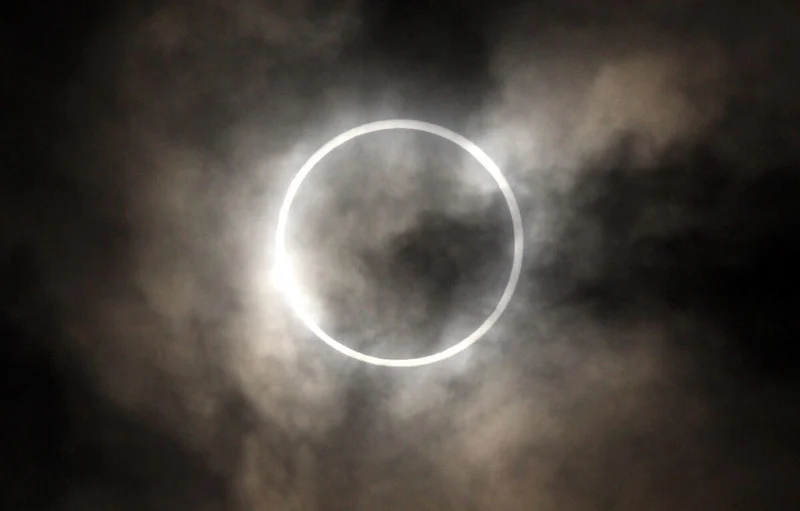


As the "ring of fire" eclipse approaches, US grid operators are preparing for their largest controlled experiment yet in managing fluctuations in renewable power. On October 14th, skies will darken, potentially causing a temporary loss of up to 28,300 gigawatts of solar generation. To put that number in perspective, it equals approximately one in nine American homes experiencing a brief power outage. While grid operators do not anticipate power shortages, this eclipse presents an opportunity to gather valuable insights for future incidents, such as next year's even larger solar eclipse, as well as for managing the increasing influx of renewable energy sources.
The upcoming annular eclipse will block a portion of solar generation along its path from Oregon to Texas. While not all solar generation will be affected, the impact will be staggered across different time zones. In California, an estimated 14,500 megawatts of solar power may be idled around 9:30 a.m., local time, compared to clear sky conditions. Roughly 20 minutes later in Texas, approximately 11,900 megawatts of solar generation may go offline. This drop in solar production will primarily come from grid-scale solar farms, although around one-fifth of the power loss will come from panels installed on households and businesses.
The Electric Reliability Council of Texas (ERCOT) anticipates a significant challenge in managing the rapid ramp-down of solar power as the eclipse moves across the state's solar farms. With more clouds expected compared to the 2017 eclipse, California and other regions may experience reduced solar power generation even without the eclipse. Moreover, the reduced solar output will coincide with lower electricity demand typically seen during fall. However, these predictions are preliminary, and the full impact of the eclipse remains to be seen.
Solar generation typically ramps up as soon as the first rays of sun hit the panels, steadily increasing over several hours. The California Independent System Operator (CAISO) estimates that solar output during the eclipse will drop at a rate of 85 megawatts per minute as it approaches its peak and then increase at a rate of 120 megawatts per minute as the eclipse passes. In comparison, on a regular day, California's maximum ramp-up is only 24 megawatts per minute.
Both California and Texas have a significant amount of installed solar generation and are experienced in managing the intermittency of renewables. Grid operators utilize various resources such as coal, natural gas units, battery storage, and demand response to address these challenges. For the upcoming eclipse, CAISO plans to utilize battery, hydro, and gas-powered resources to ensure sufficient supply. However, the eclipse will affect not only large-scale solar facilities but also rooftop solar installations, which could increase electricity demand in both states.
In addition to California and Texas, other states along the eclipse's path, including Nevada, Utah, Arizona, Colorado, and New Mexico, will also face similar challenges. The broader western region, which accounts for 16,700 megawatts of solar capacity, will experience a 65% to 90% reduction in solar generation. Moreover, even states outside the direct path of the eclipse will feel its impact. For instance, the Midcontinent Independent System Operator may see up to 1,000 megawatts of solar capacity go offline, while New York expects 730 megawatts of solar power to be unavailable during the event.
This annular eclipse serves as a test run for the total solar eclipse scheduled for next April, where the sun will be completely obscured. Once again, Texas will be directly in the eclipse's path, further impacting its growing solar generation. Despite the predictability of these events, the high penetration of solar power on the California and Texas grids compared to previous eclipses may result in some price volatility. Energy prices dropped during the full eclipse of 2017, but in California, spot power prices plummeted to negative levels as solar generation surged afterwards. Price spikes may occur if there is a sudden surge in demand and more expensive supply needs to be brought online swiftly.
Furthermore, eclipses offer an opportunity to test demand response and consumers' ability to curtail their energy usage for short periods, reducing stress on the grid. Managing millions of thermostats during the eclipse presents a straightforward approach to flexible demand management. As the transition to clean energy continues, managing the grid will become increasingly important, especially during periods of reduced generation. This eclipse provides a glimpse into the future challenges grid operators will face as renewable energy penetration grows.