


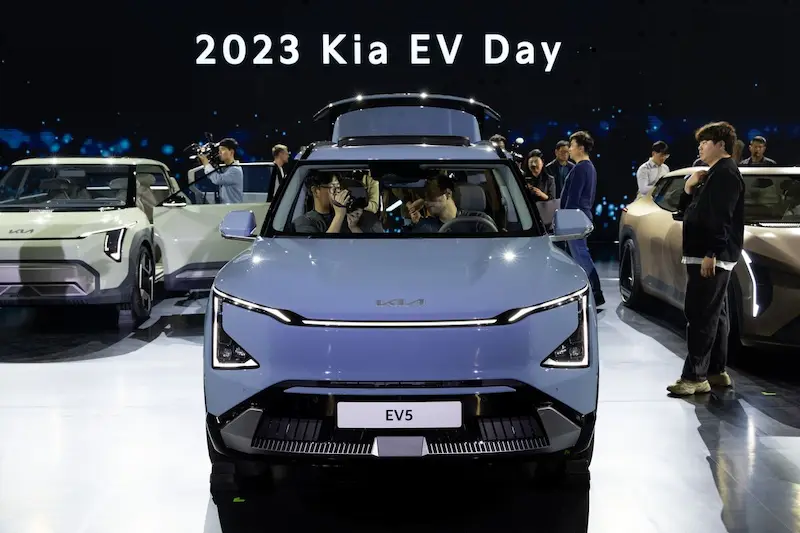


Kia Corp. has unveiled an exciting lineup of electric vehicles (EVs) as part of its strategy to cater to budget-conscious drivers. The company introduced the EV5, a compact electric sport-utility vehicle, at its recent EV Day event. Designed for millennial families, the EV5 will be available in the Chinese market with two battery options. The standard model will come with a 64 kWh battery and offer a range of 530 kilometers (330 miles), while the long-range version will feature an 88 kWh battery achieving an impressive range of 720 kilometers per charge. Kia will also manufacture slightly different models for the Korean market, tailored to meet local demands.
The EV5 is equipped with two 12.3-inch screens for instrument display and infotainment purposes, along with a 5-inch climate control display. The Chinese version of the car will have a front bench seat and a rear seat that can be folded flat to transform into a bed, making it ideal for camping or long drives. Additionally, it will include a 4-liter refrigerator and a warming unit to store food and drinks. Production of these innovative vehicles is slated to start around 2025 at Kia's factories in China and Korea.
In addition to the EV5, Kia also showcased two concept cars: the EV3, a compact version of its flagship EV9, and the EV4, a four-door sedan with a sporty appearance. Together, these three models are part of the automaker's plan to introduce smaller EVs priced between $35,000 and $50,000, with higher-end models reaching up to $80,000. This lineup is aimed at accelerating the widespread adoption of battery-powered cars.
To achieve its goal of selling 1.6 million EVs by 2030, Kia plans to have eight production facilities by 2025. In Europe, the focus will be on manufacturing small and medium-size EVs, while in China, the company will produce mid and large-size vehicles. In India, Kia will concentrate on developing strategically designed EV models tailored for emerging markets.
Kia's CEO, Ho Sung Song, emphasized the importance of reducing the cost of EVs. He stated that the company needs to deeply study ways to decrease prices further, with a goal of producing vehicles priced below $25,000. He also mentioned the possibility of adopting different sales strategies, such as selling vehicles without batteries, which customers can then rent.
According to analysts at Goldman Sachs Group, battery prices are expected to fall to $99 per kWh by 2025 due to technological advancements and the development of new lithium reserves. Lower battery costs would significantly contribute to making EVs more affordable for consumers.
In terms of market share, Kia and its affiliate Hyundai Motor Co. currently rank seventh globally in EV sales, having sold approximately 374,000 EVs in the first eight months of 2023. However, their combined market share has slightly declined from 5.4% in 2022 to 4.3% this year, primarily due to the strong growth of China's BYD Co., according to SNE Research.
Looking ahead, Kia plans to introduce a compact model called EV2 in Europe. This move comes in the midst of the European Union's investigation into China's EV subsidies, which could potentially lead to tariffs on cars made in China. This situation might present an opportunity for Kia to benefit from the European market by offering its uniquely designed EV2 model produced within Europe.
Kia's push to expand its EV lineup, focus on affordability, and increase production capacity demonstrates its commitment to electrification. With the introduction of innovative models like the EV5, Kia aims to capture the attention of budget-conscious consumers and play a significant role in the global EV market.