


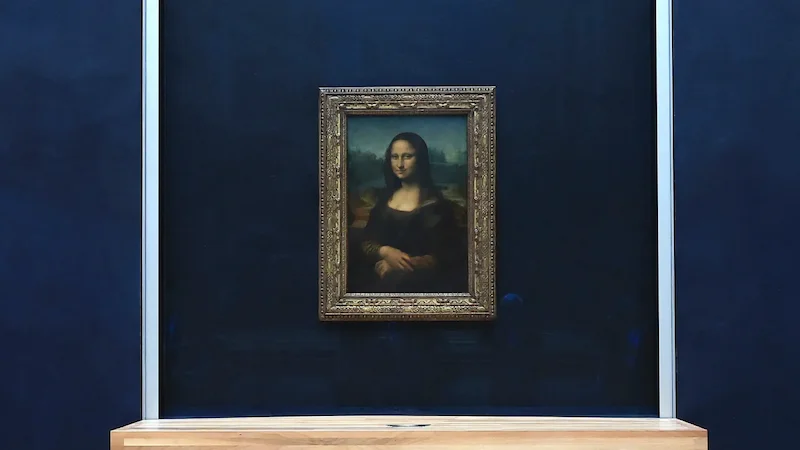


Leonardo da Vinci was a true Renaissance man, renowned for his artistic prowess, inventive mind, and scientific curiosity. Now, a new study suggests that the master artist may have been an innovative chemist as well. Through the use of X-ray diffraction and infrared spectroscopy, a team of scientists from France and Britain has made an intriguing discovery within da Vinci's famous "Mona Lisa" painting. They detected the presence of a rare mineral compound, shedding new light on the artist's painting techniques.
The compound, known as plumbonacrite, was found in the base layer of the paint, along with lead white pigment and oil. This mineral, which forms when lead oxides combine with oil, had previously only been identified in works by artists from the 17th century such as Rembrandt. Its presence in the "Mona Lisa" suggests that da Vinci may have been the precursor to this technique, unknowingly pioneering a painting method that would be employed by future artists.
Gilles Wallez, a professor at Sorbonne University in Paris and an author of the study, remarks on the significance of this finding, stating that anything related to da Vinci is inherently fascinating due to his multidisciplinary nature. Da Vinci's inquisitive mind led him to explore various fields, from art to chemistry and physics. These discoveries indicate that he was not only an exceptional artist but also a forward-thinking experimenter striving to expand the scientific knowledge of his time.
The "Mona Lisa," like many other 16th-century paintings, was created on a wooden panel that required a thick base layer. In their analysis, the researchers deduced that da Vinci likely mixed lead oxide powder with linseed oil to produce the required dense coat of paint for the initial layer. Unbeknownst to him, this process inadvertently led to the formation of the rare plumbonacrite compound.
Studying the "Mona Lisa" poses a challenge for researchers as they cannot take samples directly from the artwork, which is safely displayed behind glass at the Louvre in Paris. However, using a microsample obtained in 2007 from an area just behind the frame, scientists employed a state-of-the-art synchrotron particle accelerator, enabling them to perform a detailed molecular analysis of the paint composition.
The investigation extends further, as the same chemical makeup was discovered in the base layer of da Vinci's mural "The Last Supper," even though it was painted on a wall. The team examined a larger collection of samples—17 in total—from paint flakes that had naturally deteriorated over time. These findings underscore da Vinci's consistent approach and innovative techniques across different mediums.
With fewer than 20 known paintings created by da Vinci in his lifetime, each discovery offers valuable insights into the artist's methods and creative process. William Wallace, a distinguished professor and art history expert at Washington University in St. Louis, acknowledges da Vinci's relentless experimentation and pursuit of unconventional techniques to bring his artwork to life. As researchers continue to delve into his works, there is hope that more revelations about this extraordinary artist will come to light.
The latest study not only deepens our understanding of da Vinci's artistic genius but also highlights his pioneering spirit and contributions to the field of chemistry. Leonardo da Vinci's legacy truly extends far beyond his iconic paintings, revealing the boundless extent of his intellectual and creative capacities.