


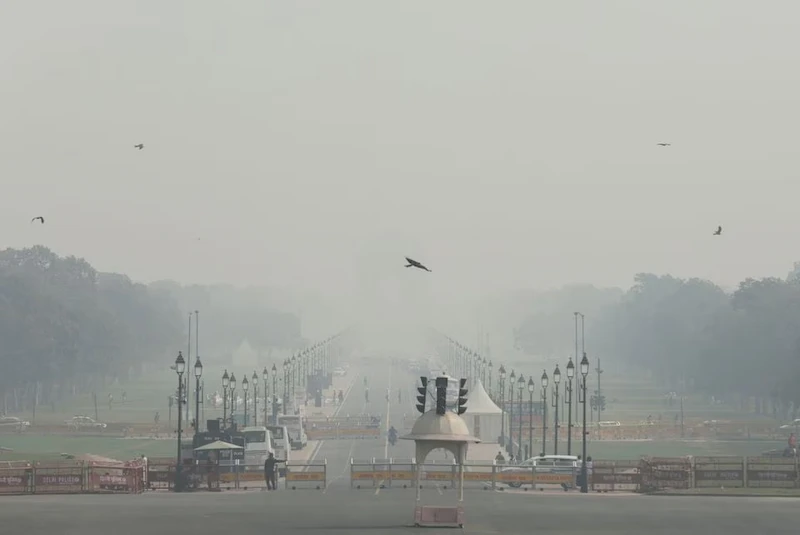


Amidst rising concerns over air pollution, the city of Delhi in India has announced that it will restrict the use of vehicles next week in an effort to curb the hazardous levels of pollution. Despite previous mitigation efforts, the air quality in the capital has remained dangerously unsafe for a third consecutive day. Delhi consistently ranks among the world's most polluted cities, particularly before winter sets in, when calm winds and low temperatures trap pollutants from various sources such as vehicles, industries, construction dust, and crop residue burning.
On Monday, the city woke up to a thick smog enveloping important landmarks like the federal secretariat and president's palace, significantly reducing visibility. In response to public outrage and the deteriorating air quality, the government has extended the closure of primary schools until November 10. Furthermore, in anticipation of pollution levels rising after the Hindu festival of Diwali on November 12 (despite a ban, firecrackers are often set off during this festival), the local government plans to implement the "odd-even" vehicle rule from November 13-20.
Under the odd-even rule, vehicles with odd registration numbers will be allowed on the roads on odd dates, while vehicles with even numbers will be permitted on alternate days. However, environmental experts have previously criticized the effectiveness of this rule, stating that while it may de-congest roads, it does little to bring down pollution levels.
Gopal Rai, the local environment minister, announced the decision, stating that the odd-even rule would be imposed in light of the rising pollution levels. He also mentioned that a meeting would be held with the police and transport department to discuss the implementation. As of Monday, the air quality in Delhi remained in the "severe" category for the third consecutive day, making it the second most polluted city in the world, trailing behind Lahore in Pakistan according to a real-time compilation by Swiss group IQAir.
Despite the alarming air quality, a cricket World Cup match between Sri Lanka and Bangladesh took place in Delhi with additional measures to reduce air pollution. Organizers installed air purifiers in the players' dressing rooms and used water sprinklers to minimize pollutants in the air.
In addition to the vehicle restrictions, there are already bans on construction work for public projects in the national capital region and restrictions on the entry of trucks and heavy vehicles into Delhi. These measures were imposed by a federal pollution control watchdog on Sunday in an attempt to combat the issue.
An analysis conducted by the Down To Earth magazine, published on Sunday, revealed that poor air quality in Delhi is linked to various health issues such as low birth weight, preterm delivery, stillbirth, developmental delay, restricted growth in children, and even death.
In conclusion, Delhi's decision to enforce the odd-even vehicle rule aims to tackle the alarming air pollution levels in the city. While the efficacy of such measures has been debated in the past, urgent action is necessary to combat the adverse health effects and improve the overall well-being of the citizens.