


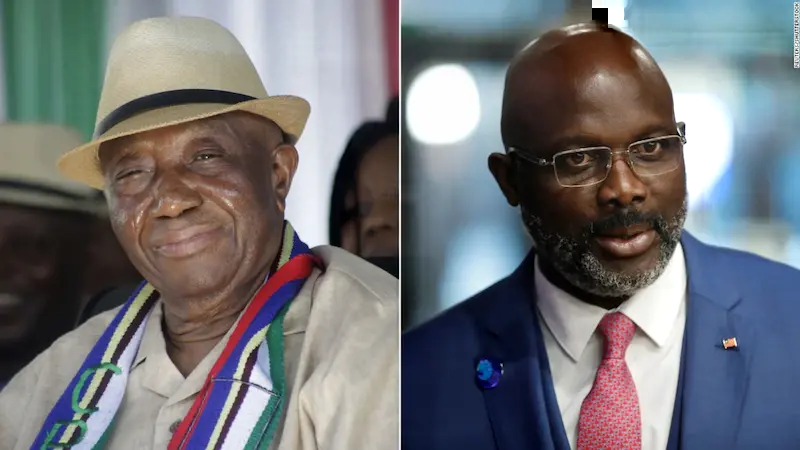


Liberians went to the polls on Tuesday in a closely contested run-off election between President George Weah and former vice president Joseph Boakai. The two old rivals faced off once again, with voters eagerly awaiting the outcome of what is expected to be a tightly fought vote. Weah, a former soccer star who came to power in 2018, narrowly won the first round of voting with just 7,000 more votes than Boakai. However, he fell short of the required 50% to secure an outright victory.
Weah's first term in office has been marred by allegations of corruption and persistent poverty, leaving many voters underwhelmed and seeking change. Future Barbour, a mother of four, expressed her concerns, stating, "I am voting because I need peace, more development... My children are not going to school because I have no job." Weah has pleaded for more time to fulfill his promises of eradicating corruption and improving livelihoods, acknowledging that the nation still grapples with the aftermath of civil wars and the Ebola epidemic.
On the other hand, Boakai, who lost to Weah in the 2017 election, has campaigned on the need to rescue Liberia from what he perceives as mismanagement by the current administration. Both candidates have garnered endorsements from unsuccessful candidates from the first round, adding further intrigue to the run-off election. Additionally, the voting preference of the 6% of people whose ballots were invalidated in the first round remains unknown.
Despite high anticipation, the voter turnout appeared to be lighter compared to the record 79% in the initial round. Boakai attributed this to the usual trend of lower turnout during run-off elections. However, he accused Weah's party of attempting to hinder the voting process without providing specific details. Boakai assured reporters of their vigilance in monitoring such activities.
The peaceful electoral period did witness sporadic clashes between rival factions, resulting in two fatalities. Moreover, logistical challenges caused delays in voting across some rural areas during the first round. Therefore, any alleged irregularities in the run-off election have potential to escalate tensions. Fortunately, there were no reports of significant problems during the early hours of voting on Tuesday.
For Weah, this election becomes a crucial test of his popularity as he seeks to cement his position as Liberia's leader. Despite his cult-like support in certain regions, which stems from his inspiring journey from a Monrovia slum to international soccer stardom, Weah has faced challenges in tackling widespread poverty and corruption. While the economy recorded a growth of 4.8% in 2022, driven by gold production and agricultural harvest, over 80% of the population still faces food insecurity.
With a vision for a brighter future, voters like Samuel Carr are seeking change. Carr emphasized, "I am voting for my children's future... to have a free country where there will be no armed robbery, where children can move freely. I want to see a better Liberia." As the race comes to a close, Liberians eagerly await the results, hoping that the outcome will pave the way for a transformed and prosperous Liberia.